


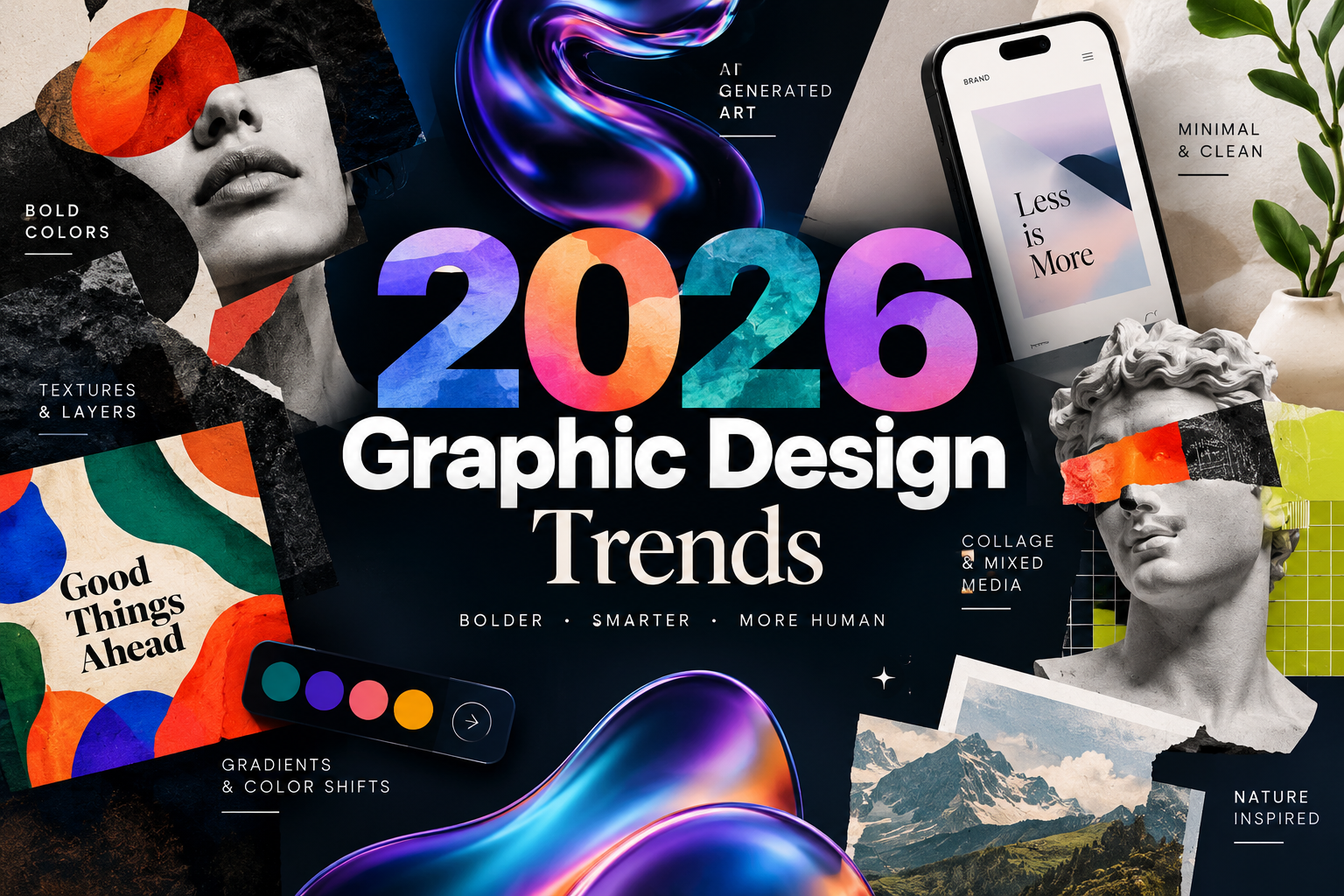
10 INSPIRING IDEAS FOR MODERN BRANDS
Graphic design is changing faster than ever. New technologies, generative AI, changing consumer expectations, social media, digital experiences, and advances in printing are transforming the way brands communicate visually. But one of the most interesting developments in the graphic design trends 2026 landscape is that technology is not making design less human. In many ways, it is doing the opposite.
As AI-generated images and highly polished digital graphics become easier to produce, designers are increasingly looking for visual approaches that feel authentic, distinctive, tactile, emotional, and unmistakably human. This is one of the central ideas behind many of the graphic design trends 2026:
brands are moving away from generic perfection and toward visual identities with more personality.
Designers are experimenting with imperfect shapes, tactile textures, expressive typography, bold compositions, cultural references, analog-inspired graphics, and more intentional uses of artificial intelligence. At the same time, minimalism has not disappeared. Instead, it is evolving into a more strategic form of simplicity.
For brands, this creates an exciting opportunity. The goal is no longer simply to follow the latest visual trend. The goal is to understand why a trend is becoming popular and determine whether it can make a brand more recognizable, relevant, and memorable.
In this guide, we explore the most important graphic design trends 2026 and examine how they can influence branding, visual identity, packaging, labels, and modern print design.
WHY GRAPHIC DESIGN IS CHANGING IN 2026
Before looking at individual graphic design trends 2026, it is important to understand why visual communication is changing. The design industry is experiencing several major shifts at the same time.
First, artificial intelligence has dramatically increased the speed at which designers can explore ideas. Creating an image, illustration, concept, moodboard, or visual variation can now take minutes instead of hours. Second, audiences are exposed to an enormous amount of visual content every day. Social media feeds, websites, advertisements, packaging, applications, and digital platforms compete constantly for attention. Third, brands are discovering that simply looking professional is no longer enough.
A professional-looking visual identity can still feel generic. This is why differentiation has become increasingly important. When thousands of brands can access similar design tools, templates, stock images, and AI systems, the strongest brands need something more distinctive.
- They need personality.
- They need a recognizable visual language.
- They need a reason for customers to remember them.
That is why many of the graphic design trends 2026 are focused on authenticity, emotion, individuality, and sensory experiences rather than pure visual perfection.
GRAPHIC DESIGN TRENDS 2026: THE RISE OF HUMAN-CENTERED DESIGN
One of the most important ideas behind graphic design trends 2026 is the growing importance of human-centered design. For many years, digital design moved toward increasingly perfect visuals. Everything became smoother. Interfaces became cleaner. Photography became sharper. Layouts became more systematic. Typography became increasingly controlled. Artificial intelligence has accelerated this process even further.
Today, a designer can generate an incredibly polished visual in seconds. But this creates a new problem. If everyone can create polished visuals, polish itself becomes less distinctive. A perfect AI-generated image may look impressive, but if thousands of brands use similar visual styles, it becomes difficult to remember. Human-centered design offers another direction.
Instead of asking:
“How perfect can this design become?”
designers are increasingly asking:
“How can this design feel more authentic and meaningful?”
Human-centered graphic design can include:
– Hand-drawn illustrations
– Organic shapes
– Handwritten typography
– Natural textures
– Analog photography
– Visible imperfections
– Personal storytelling
– Cultural references
– Unexpected compositions
– Tactile visual elements
The objective is not to make design look unfinished. The objective is to make it feel intentional, personal, and emotionally relevant. This is one of the strongest principles behind the graphic design trends 2026.
IMPERFECT DESIGN BECOMES A STRATEGIC CHOICE
One of the most interesting graphic design trends 2026 is the growing popularity of intentional imperfection. For years, designers were encouraged to make everything perfectly aligned, perfectly smooth, and perfectly consistent.
Now many designers are deliberately introducing elements that appear less mechanical. Examples include:
– Rough edges
– Hand-drawn lines
– Uneven shapes
– Collage-style compositions
– Handwritten notes
– Irregular typography
– Paper textures
– Film grain
– Handmade illustrations
– Visible printing characteristics
This approach is sometimes described as imperfect design.

However, there is a major difference between poor execution and intentional imperfection. Poor execution happens because the designer failed to control the design.
Intentional imperfection happens because the designer deliberately introduces an organic element into a controlled system. That distinction is critical. A premium brand could use a subtle paper texture. A food brand might use hand-drawn illustrations. A fashion brand might use experimental typography. A creative studio might deliberately combine photography, handwritten elements, and collage.
In each case, imperfection becomes part of the brand language. For businesses, this can make a visual identity more memorable because it introduces characteristics that are difficult to reproduce through generic templates.
TACTILE AND SENSORY GRAPHIC DESIGN
Another major direction among graphic design trends 2026 is the increasing importance of tactile visual experiences. Most modern communication is digital. People spend hours looking at flat screens. As a result, anything that suggests physical material can create a stronger emotional response. Designers are therefore experimenting with visual representations of:
– Paper
– Fabric
– Glass
– Metal
– Wood
– Stone
– Ink
– Plastic
– Natural materials
– Handmade surfaces
Texture can make a digital design feel physical.
This trend becomes even more interesting when graphic design moves from the screen into physical printing. Packaging and labels provide designers with real opportunities to turn visual concepts into physical experiences. For example, a label can combine:
– Embossing
– Debossing
– Metallic foil
– Tactile varnish
– Textured paper
– Matte finishes
– Gloss finishes
– Special inks
– Die-cut shapes
This means that the designer does not necessarily have to imitate texture digitally. The texture can actually exist on the final printed product. This is one reason the graphic design trends 2026 are particularly relevant to packaging and label design. The boundary between graphic design and print production is becoming more important, not less.
EXPRESSIVE TYPOGRAPHY AND EXPERIMENTAL LETTERING
Typography is becoming increasingly expressive. Instead of treating text purely as information, designers are using typography as an important visual element. This can include:
– Oversized headlines
– Custom lettering
– Distorted type
– Rounded typography
– Handwritten fonts
– Variable fonts
– Experimental spacing
– Unusual line breaks
– Three-dimensional type
– Typography integrated with photography
The important point is that expressive typography should support the brand rather than simply follow a trend. A technology company might benefit from precise geometric typography. A luxury brand might require elegant and restrained type. A food brand could use organic or handcrafted lettering. A fashion brand may experiment with oversized or unconventional typography.
The best graphic design trends 2026 do not simply tell designers what fonts to use. They encourage designers to think more deeply about how typography communicates personality. Typography can communicate:
– Trust
– Luxury
– Energy
– Youth
– Heritage
– Innovation
– Simplicity
– Craftsmanship
That makes typography one of the most powerful components of visual identity.
AI AND THE NEW ROLE OF THE DESIGNER
Artificial intelligence is perhaps the biggest technological factor influencing graphic design trends 2026. AI can now assist with:
– Image generation
– Concept development
– Moodboards
– Visual exploration
– Copywriting
– Image editing
– Background generation
– Style exploration
– Creative variations
– Early-stage ideation
This dramatically changes the creative workflow. A traditional process might look like:
Brief → Research → Sketch → Design → Revision → Final
An AI-assisted process can look more like:
Brief → Research → AI Exploration → Selection → Art Direction → Design → Refinement → Production
The difference is important. AI can generate possibilities. But possibilities are not the same as solutions. A designer still needs to determine:
– Which concept fits the brand?
– Which image communicates the right message?
– Which typography works?
– Which colors are appropriate?
– Which visual system is scalable?
– Which design can actually be produced?
– Which concept will remain relevant?
This means the designer’s role is evolving.
Instead of being only a producer of visual assets, the designer increasingly becomes a creative director, curator, strategist, and decision-maker. This is one of the most important graphic design trends 2026 because it changes not only what designers create, but how they work.
GRAPHIC DESIGN TRENDS 2026 AND THE EVOLUTION OF MINIMALISM
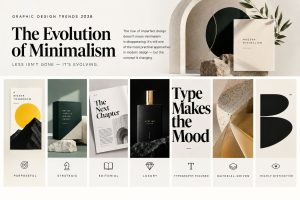
Minimalism is not dead. In fact, minimalism remains one of the most useful approaches in modern graphic design. What is changing is the way minimalism is being used. Older interpretations of minimalism often focused on removing almost everything:
– Few colors
– Large amounts of whitespace
– Simple typography
– Minimal graphics
– Limited visual elements
Modern minimalism is more strategic. Instead of removing elements simply to make a design look clean, designers are asking which elements deserve attention. This can result in:
– Stronger typography
– More deliberate spacing
– Carefully selected colors
– Simple but distinctive symbols
– High-quality photography
– Better visual hierarchy
– Stronger brand recognition
The result is a design that can be simple without being generic. This is an important lesson when studying graphic design trends 2026. Trends should not be interpreted literally. The goal is not to copy a visual style. The goal is to understand the design principle behind it.
AUTHENTICITY, CULTURE, AND LOCAL VISUAL IDENTITY
Globalization has created an interesting challenge for brands. Design trends spread internationally almost instantly. A style that becomes popular in New York can appear in London, Seoul, Dubai, Tokyo, and other markets within weeks.
This creates opportunities for designers, but it also creates visual sameness. If every brand uses the same colors, fonts, layouts, AI imagery, and visual effects, differentiation becomes difficult. One response is greater cultural authenticity. Brands are increasingly exploring:
– Local typography
– Regional patterns
– Traditional craftsmanship
– Local photography
– Cultural symbols
– Historical references
– Regional materials
– Local storytelling
The goal is not to make a brand look old-fashioned. The goal is to combine contemporary design principles with authentic cultural identity.
This can create a visual identity that feels modern without looking like every other brand. For international brands, cultural awareness can also make communication more relevant to specific markets. For local brands, it can become a competitive advantage.
BOLD COLORS AND MORE EMOTIONAL VISUAL SYSTEMS
Color remains one of the most powerful tools in graphic design. One of the broader graphic design trends 2026 is the move toward more intentional and emotionally expressive color systems. Brands are increasingly exploring combinations that create stronger emotional reactions rather than simply choosing safe corporate palettes. Depending on the industry, this might involve:
– Saturated colors
– Unexpected color combinations
– Soft natural palettes
– High-contrast systems
– Warm colors
– Retro-inspired palettes
– Metallic color references
– Monochromatic systems
However, color trends should always be considered in the context of brand strategy. A pharmaceutical company may require a different color language from a children’s food brand. A luxury packaging system may benefit from restrained colors and metallic accents. A technology startup may choose vibrant colors to communicate energy and innovation. The strongest visual identities do not use color because it is fashionable. They use color because it communicates something specific.
GRAPHIC DESIGN TRENDS 2026 FOR PACKAGING AND LABEL DESIGN
The influence of graphic design trends 2026 becomes especially visible when design is applied to physical products. Packaging has a unique advantage over digital design:
- People can touch it.
- They can hold it.
- They can see it from different angles.
- They can feel the material.
- They can notice the printing quality.
This makes packaging an ideal environment for tactile and human-centered design. For example, an organic food brand could combine natural colors, hand-drawn illustrations, and textured paper. A premium cosmetic product might combine restrained typography, metallic foil, embossing, and a minimal layout. A pharmaceutical or supplement brand might use a clean visual hierarchy while incorporating subtle tactile elements to communicate quality. A beverage brand could use expressive typography and bold color combinations to stand out on a crowded shelf.
The important lesson is that graphic design does not end when the artwork is exported. The final production process matters.
A design should consider:
– Printing method
– Substrate
– Ink
– Finishing
– Die-cutting
– Foil
– Varnish
– Embossing
– Color accuracy
– Production limitations
This is where professional graphic design and print production need to work together. A beautiful design that cannot be produced efficiently is not necessarily a successful packaging design.
HOW BRANDS SHOULD USE DESIGN TRENDS WITHOUT LOSING THEIR IDENTITY
Following every design trend is one of the fastest ways to create an inconsistent brand. Imagine changing your typography every year. Changing your colors every time a new trend appears. Changing your logo because a new style becomes popular. Changing your packaging because another visual language becomes fashionable.
The result may look modern temporarily, but the brand becomes difficult to recognize. A stronger strategy is to distinguish between:
TREND and BRAND IDENTITY.
A trend can influence a campaign, product launch, packaging collection, or seasonal design. The core brand identity should remain more stable. Before adopting a trend, ask:
1. Does this trend fit our brand personality?
2. Does it improve communication?
3. Does it make the brand more distinctive?
4. Does it make sense for our audience?
5. Can we produce it consistently?
6. Will the design still work if the trend disappears?
7. Does the trend support our business objectives?
If the answer to most of these questions is yes, the trend may be worth adopting. If not, it may be better to ignore it.
WHICH GRAPHIC DESIGN TRENDS 2026 ARE LIKELY TO LAST?
Not every trend will survive. Some visual styles are short-lived. Others represent deeper changes in technology and consumer behavior. Several directions appear more durable.
- First is human-centered design. As AI-generated content becomes more common, authentic human expression may become more valuable.
- Second is tactile design. Digital experiences continue to dominate communication, which can make physical sensory experiences more distinctive.
- Third is strategic AI use. AI is likely to remain part of the creative workflow, even as designers develop better ways to control and refine AI-generated content.
- Fourth is cultural authenticity. Brands will continue searching for ways to distinguish themselves from generic global aesthetics.
- Fifth is expressive typography. Typography will remain one of the most flexible ways to communicate personality.
- Sixth is strategic simplicity. Minimalism will continue to work when it is supported by strong brand strategy.
The exact visual appearance of these trends will change, but the underlying principles are likely to remain important.
HOW TO APPLY THESE TRENDS TO A REAL BRAND
Knowing graphic design trends 2026 is useful. Knowing how to apply them is more valuable. Imagine a company preparing to launch a new consumer product. Instead of immediately asking a designer to “make it modern,” the brand could start with a strategic process.
Step 1: Define the audience.
Who is going to buy the product?
Step 2: Define the brand personality.
Is the brand premium, playful, scientific, natural, innovative, traditional, or youthful?
Step 3: Study competitors.
What visual patterns dominate the category?
Step 4: Identify opportunities.
Where does the category look repetitive?
Step 5: Select relevant design trends.
Choose only the trends that support the brand.
Step 6: Develop a visual system.
Define typography, colors, imagery, layout, icons, illustrations, and material choices.
Step 7: Test the design.
Test the identity across:
– Website
– Social media
– Packaging
– Labels
– Advertising
– Printed materials
Step 8: Consider production.
Make sure the design works with the actual printing and manufacturing process.
Step 9: Measure recognition.
A successful identity should become easier to recognize over time.
This approach is much stronger than simply copying the latest graphic design trend.
WHY HUMAN CREATIVITY STILL MATTERS
The rise of AI does not mean that human creativity is becoming irrelevant. In fact, the opposite may be true. When producing visual assets becomes easier, strategic thinking becomes more valuable. A brand does not need another random image. It needs the right image. It does not need another fashionable font. It needs the right typography. It does not need another beautiful package. It needs packaging that communicates the right message and makes the product recognizable.
AI can accelerate exploration. Designers provide judgment. Brands provide purpose. Print technology provides physical execution. The strongest results happen when all four work together.
FINAL THOUGHTS ON GRAPHIC DESIGN TRENDS 2026
The most important lesson from graphic design trends 2026 is that modern design is not simply becoming more technological. It is becoming more intentional. Artificial intelligence is making creative exploration faster. At the same time, brands are searching for ways to appear more authentic. Digital platforms are becoming more dominant. At the same time, tactile and physical experiences are becoming more valuable.
Design tools are becoming more powerful. At the same time, creative judgment is becoming more important. This apparent contradiction may define the next stage of graphic design. The future is not necessarily perfectly polished design. It is not necessarily maximalism. It is not necessarily minimalism. It is not simply AI-generated creativity.
Instead, the strongest direction appears to be a combination of technology and human judgment. For brands, the opportunity is clear. Use new technology to explore more possibilities. Use design strategy to select the right direction. Use authentic visual language to build recognition. And when the design becomes physical through packaging and labels, use printing technology to turn the visual idea into a memorable brand experience. The best graphic design trends 2026 are therefore not simply trends to copy.
They are ideas that designers can use to create more distinctive, meaningful, and effective visual identities. In a world where almost, anyone can generate an image, the brands that stand out will be the ones that have something meaningful to say — and a visual identity strong enough to make people remember it.
Sources & Further Reading
- Canva — 2026 Design Trends: Imperfect by Design — useful for the 2026 trend framework and research behind the “Imperfect by Design” movement.
- Adobe Express — Design Trends for 2026 — covers expressive typography, tactile visuals and broader 2026 graphic-design directions.
- Adobe — 2026 Creative Trends Forecast — useful reference for human connection, sensory design, cultural authenticity and AI-era creativity.
- Adobe — How AI Is Redistributing Creative Work — research on how AI is changing, rather than simply eliminating, creative work.
To build a strong internal linking structure around this article, connect it to relevant pages on the website:
- About Amin Lesani — link to the personal profile page
- Brand Identity & Packaging Services — link to the relevant services page
- Label & Packaging Portfolio — link to the main portfolio archive
- Brand Stories — link to the Brand Stories category
- Design & Printing Articles — link to the relevant blog category