


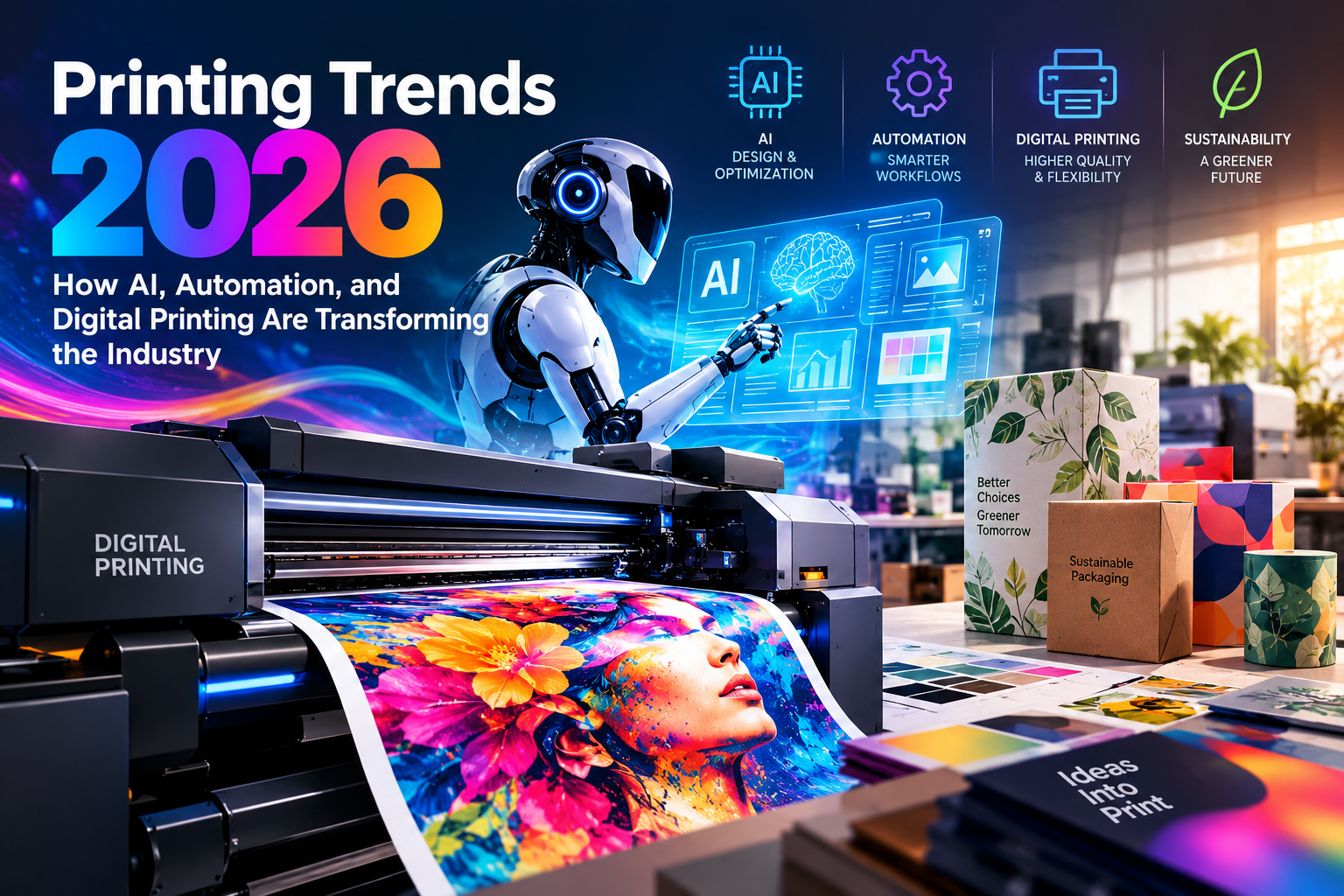
Why Printing Trends 2026 Matter
Printing trends 2026 are revealing a fundamental change in how the printing industry operates. Printing is no longer simply about transferring ink onto paper, film, labels, or packaging materials. The industry is increasingly becoming digital, automated, data-driven, personalized, and connected.
Artificial intelligence is entering production workflows. Digital printing is expanding into packaging and labels. Automation is reducing repetitive production tasks. Shorter print runs are becoming more common, while brands increasingly expect personalization, variable data, rapid turnaround, and flexible production.
At the same time, packaging itself is becoming more intelligent. QR codes, NFC, RFID, serialization, authentication technologies, and variable data can turn a printed label or package into a connection between a physical product and a digital experience.
FESPA’s 2026 industry coverage identifies AI, smart packaging, and sustainability as important areas shaping the future of printing. Smithers also identifies continued growth in digital printing for packaging and labels, demonstrating that digital production is becoming increasingly important in the packaging sector. For print companies, label converters, packaging manufacturers, and brands, understanding these developments is becoming increasingly important.
The Printing Industry Is Entering a New Era
For much of its history, commercial printing followed a relatively straightforward production model. A customer supplied artwork. The printer prepared the files. The production team selected the appropriate printing process. The job was printed, finished, packaged, and delivered.
That model still exists, but today’s customers often expect much more. A modern brand may require dozens of product variations, multiple packaging sizes, different languages, personalized campaigns, unique identifiers, short production runs, and rapid delivery. A packaging manufacturer may have to manage hundreds of jobs with different substrates, colors, finishing requirements, quantities, and deadlines.
This creates a major challenge. The number of jobs can increase while the average quantity per job becomes smaller. HEIDELBERG has highlighted this shift toward increasing job complexity, shorter runs, and the need for greater digitalization and automation. This is one of the reasons the printing trends 2026 conversation is not limited to printing presses.
The transformation involves the entire workflow:
- Design
- Prepress
- Workflow management
- Color management
- Printing
- Inspection
- Finishing
- Data management
- Inventory
- Scheduling
- Logistics
The printing press is increasingly becoming one part of a connected manufacturing system.
Printing Trends 2026: From Printing to Intelligent Manufacturing
One of the biggest changes in printing trends 2026 is the movement from traditional print production toward intelligent manufacturing. Imagine a printing company receiving hundreds of jobs every day. Every job can have different:
- Quantities
- Substrates
- Colors
- Finishing requirements
- Deadlines
- Machine requirements
- Artwork versions
Managing this complexity manually can be difficult.
Modern workflow systems can collect production information and automatically route jobs according to predefined rules. Artificial intelligence can potentially go further by analyzing historical production data and recommending optimized production sequences. Automation can then execute those processes with fewer manual interventions.
This creates a new production model:
Data → Decision → Automation → Production → Quality Control
The result is a printing operation that can become faster, more predictable, and more scalable.
Trend #1: Digital Printing Is Expanding Into Packaging
One of the strongest printing trends 2026 is the continued expansion of digital printing into labels and packaging. Digital printing has existed for decades, but its role in industrial production continues to evolve. It is increasingly being used for:
- Labels
- Folding cartons
- Flexible packaging
- Corrugated packaging
- Short-run packaging
- Promotional packaging
- Personalized packaging
- Variable-data applications
Smithers forecasts significant growth in digital packaging and label printing over the coming years. This does not mean conventional printing is disappearing. Instead, digital printing is taking a larger role in applications where flexibility is particularly valuable.
Why Digital Printing Is Growing
The major advantage of digital printing is flexibility. Traditional analog printing processes can be highly efficient for long production runs, but they can require substantial setup and preparation. Digital printing can reduce some of those setup requirements. This makes it attractive when customers need:
- Short production runs
- Multiple SKUs
- Frequent artwork changes
- Variable data
- Personalization
- Rapid market testing
- Regional packaging
- Seasonal campaigns
Consider a brand launching a new product.
Instead of producing a very large quantity of packaging before knowing how the market will respond, the company can produce a smaller initial quantity, test the market, and adjust future production. This approach can reduce inventory risk. Digital printing can also make multiple design variations easier to manage. For example, a beverage company might create several label designs for different cities or events.
Instead of treating every design as an entirely separate marketing project, digital production can allow multiple versions to be handled within a connected workflow. The fundamental change is simple:
Printing can become more responsive to demand.
Trend #2: AI Is Transforming Print Production
Artificial intelligence is another major component of printing trends 2026. However, AI in printing is about much more than generating images. AI can potentially support many stages of the production workflow, including:
- Preflight
- Job scheduling
- Color management
- Quality inspection
- Predictive maintenance
- Production planning
- Variable-data generation
- Personalization
- Defect detection
- Inventory optimization
FESPA has specifically identified AI applications in printing operations, including prepress, scheduling, color management, and personalized printing. This distinction matters. When people hear “AI and printing,” they often imagine AI-generated artwork. The larger opportunity may actually be operational.
How AI Can Improve Printing
Imagine a production department with 200 active jobs. Each job has different requirements. One needs a particular substrate. Another requires special finishing. Another has a strict deadline. Another needs variable data. Another needs a specific press. An AI-assisted production system could analyze these requirements and recommend an optimized schedule. For example:
Job A → Job F → Job C → Job D → Job B
The objective could be to reduce:
- Setup time
- Material changes
- Ink changes
- Waste
- Machine downtime
- Finishing bottlenecks
AI can also help with quality control. Computer vision systems can inspect printed material for problems such as:
- Registration errors
- Color variation
- Missing elements
- Printing defects
- Incorrect variable information
- Damaged barcodes
- Incorrect labels
HP has highlighted AI-enabled quality diagnostics and real-time defect detection in its digital flexible-packaging technologies. This means AI is moving beyond the design studio. AI is becoming part of the factory.
Trend #3: Automation Is Becoming a Competitive Advantage
AI and automation are closely related, but they are not the same. AI can analyze information and make predictions or recommendations. Automation executes processes with limited human intervention. Modern printing operations increasingly need both. A highly automated workflow could:
- Receive an artwork file.
- Preflight the file.
- Check technical requirements.
- Generate production-ready data.
- Assign the job to a production queue.
- Select an appropriate printing system.
- Send production information to the machine.
- Inspect the output.
- Route the job to finishing.
- Update production status.
- Generate delivery information.
This reduces repetitive manual work.
HEIDELBERG’s current technology strategy includes workflow automation, AI, robotics, digital printing, and integration across the print and packaging value chain. For print companies, this can improve:
- Productivity
- Consistency
- Production visibility
- Response time
- Cost control
Automation is therefore becoming a strategic advantage rather than simply a convenience.
Trend #4: Short-Run and On-Demand Printing
Another important development in printing trends 2026 is the growth of short-run and on-demand production. Brands are producing more variations. Marketing campaigns are becoming shorter. Product lifecycles are changing faster. E-commerce is creating fragmented demand. All of these factors can make extremely long production runs less suitable for certain applications. Digital printing is particularly well positioned for this environment.
Instead of:
Forecast → Produce → Store → Sell
businesses can increasingly move toward:
Demand → Produce → Deliver
This can reduce the risk of excess printed inventory. Packaging can become obsolete because of:
- Product redesigns
- Regulatory changes
- Ingredient changes
- New campaigns
- Seasonal promotions
- Discontinued products
Producing closer to actual demand can reduce some of these risks.
Trend #5: Personalization and Variable Data Printing
Personalization is another important part of printing trends 2026. Digital technologies allow specific information to change from one printed piece to another. A production run does not necessarily need to consist of identical copies. A label can contain:
- A unique serial number
- A unique QR code
- A regional identifier
- A promotional code
- A customer identifier
- A unique graphic
- An authentication code
HP identifies variable data, QR codes, sequential numbering, unique identifiers, and security applications as important capabilities of digital printing. This creates opportunities in both marketing and product protection.
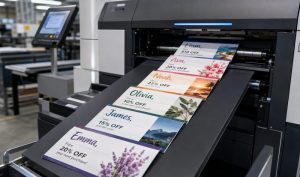
Product Authentication
Unique identifiers can help brands create authentication systems.
Traceability
Codes can connect products with production and supply-chain information.
Anti-Counterfeiting
Unique data can make unauthorized replication more difficult.
Customer Engagement
QR codes can connect packaging to digital content.
Personalized Marketing
Different customers or regions can receive different versions. These capabilities are especially relevant to industries such as pharmaceuticals, supplements, cosmetics, food, and premium consumer products.
Trend #6: Smart Packaging and Connected Labels
Perhaps the most exciting area of printing trends 2026 is smart packaging. Traditional packaging communicates primarily through printed information. Smart packaging can combine printed communication with digital connectivity. Examples include:
- QR codes
- NFC
- RFID
- Serialized identifiers
- Sensors
- Authentication systems
- Digital product information
- Connected consumer experiences
FESPA’s 2026 printing coverage highlights smart packaging applications including RFID labels, variable-data labels, authentication technologies, sensors, and QR-enabled experiences. This creates a powerful convergence:
Print + Data + Connectivity
A physical label can become the entry point to a digital experience. For example:
- A pharmaceutical package could allow customers to verify information.
- A cosmetics package could provide a product tutorial.
- A food package could provide information about origin.
- A luxury product could provide authenticity verification.
- A promotional package could unlock a digital campaign.
The printed label is no longer merely decoration. It becomes an interface.
Trend #7: Sustainable Printing
Sustainability remains another major element of printing trends 2026. However, the sustainability conversation is becoming more sophisticated. Instead of asking only whether a material is environmentally friendly, brands and printers increasingly need to evaluate the entire production system. This can include:
- Substrate selection
- Ink technology
- Production waste
- Energy consumption
- Setup waste
- Inventory
- Transportation
- Recyclability
- End-of-life considerations
Smithers has highlighted sustainable substrates, reduced waste, and new ink technologies as important developments in sustainable printing.
Digital printing can contribute to sustainability in some applications by making shorter runs and demand-driven production more practical. However, there is no universally sustainable printing technology. The environmental impact depends on:
- Run length
- Substrate
- Ink
- Finishing
- Production efficiency
- Waste
- Logistics
- Recycling infrastructure
Sustainability therefore needs to be evaluated as a system.
Digital vs. Conventional Printing
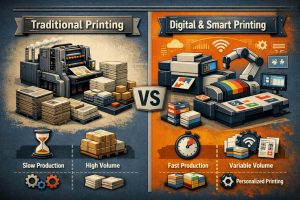
One of the biggest misconceptions surrounding printing trends 2026 is that digital printing will simply replace conventional printing. The reality is more complex. Flexography, offset, gravure, screen printing, and other conventional processes continue to have important applications.
For high-volume production, conventional printing can remain extremely efficient. Smithers continues to identify flexography as a major process in package printing while digital printing expands into additional applications. Digital printing is particularly attractive when flexibility matters.
For example:
| Requirement | Often advantageous |
|---|---|
| Very large production runs | Conventional |
| Short runs | Digital |
| Multiple versions | Digital |
| Variable data | Digital |
| Personalization | Digital |
| High-volume packaging | Conventional |
| Fast version changes | Digital |
| Hybrid workflows | Both |
The future is therefore not necessarily:
Digital vs. Conventional
It is:
Digital + Conventional
What Printing Trends 2026 Mean for Label Printing
Labels are one of the areas most strongly affected by these developments. Brands increasingly need:
- More SKUs
- Shorter runs
- Faster launches
- Variable data
- Personalization
- Authentication
- Premium finishing
- Sustainable substrates
- Rapid artwork changes
Digital printing can be particularly effective for many of these requirements. Variable data also creates new opportunities. A label converter can potentially produce multiple versions within the same production workflow. For example:
1,000 unique labels → one campaign
instead of:
1 label design → 1 production run
This changes the relationship between printing and marketing. The label becomes both a physical product and a data carrier.
What Printing Trends 2026 Mean for Packaging
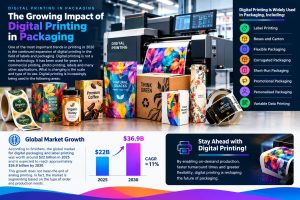
Packaging is where many of these trends converge. Modern packaging increasingly needs to be:
- Attractive
- Functional
- Sustainable
- Traceable
- Authentic
- Interactive
- Cost-efficient
- Fast to produce
This means packaging design is no longer purely visual. Production technology becomes part of the design decision. Designers increasingly need to understand:
- Materials
- Printing processes
- Color
- Finishing
- Variable data
- Regulatory requirements
- Digital connectivity
- Supply-chain requirements
For print companies, this creates an opportunity to move beyond commodity printing. A customer may not simply need someone to print artwork. They may need a production partner capable of managing the complete packaging workflow.
How Printing Companies Can Prepare
The companies that benefit most from printing trends 2026 will not necessarily be the companies that simply purchase the newest press. Technology needs to support a clear business strategy.
1. Digitize the Workflow
Start with the production workflow.
Identify:
- Manual data entry
- Repeated tasks
- Production bottlenecks
- Quality problems
- Scheduling delays
- Communication problems
Digitalizing the workflow can sometimes create substantial improvements before purchasing new production equipment.
2. Automate Repetitive Processes
Good automation targets repetitive activities such as:
- Preflight
- Job routing
- Scheduling
- Reporting
- Quality control
- Data entry
- Inventory tracking
The objective is not to use AI because it is fashionable. The objective is to eliminate unnecessary work.
3. Develop Digital Printing Capabilities
Digital printing is especially valuable when customers need:
- Short runs
- Rapid turnaround
- Multiple SKUs
- Variable data
- Personalization
Companies should analyze their customer base before deciding where digital printing provides the greatest commercial opportunity.
4. Offer More Than Printing
One of the most important changes in the industry is the movement toward higher-value services. These can include:
- Packaging design
- Label design
- Variable data
- Smart labels
- Authentication
- Serialization
- Premium finishing
- Color management
- Packaging development
This can turn a printing company into a technology-enabled production partner.
5. Measure Sustainability
Instead of relying on vague environmental claims, companies should track measurable indicators. Examples include:
- Material waste
- Setup waste
- Energy consumption
- Ink consumption
- Production efficiency
- Recyclability
- Transportation
Measurement makes sustainability more meaningful.
What Will Happen to Traditional Printing?
Traditional printing is not disappearing. Conventional technologies remain highly valuable for many applications. Flexography remains important in packaging. Offset continues to be widely used for commercial printing. Gravure remains relevant in high-volume applications. Screen printing has specialized applications.
The transformation is therefore not about eliminating traditional printing. Instead, production is becoming more specialized. A modern printing operation may combine:
- Offset
- Flexography
- Digital inkjet
- Electrophotographic digital printing
- Hybrid presses
- Automated finishing
- Robotics
- AI-driven workflow systems
Each technology can perform the jobs for which it is economically and technically appropriate.
The Future of Printing Is Hybrid
The most important conclusion from printing trends 2026 is that the future is likely to be hybrid. A brand may use conventional printing for very large production runs. Digital printing may handle short-run variations.
AI may optimize production schedules. Automation may move jobs between systems. Variable data may personalize individual packages. QR codes and NFC may connect products to digital experiences. Advanced finishing may create premium physical experiences.
Sustainable substrates may reduce material impact. These technologies do not need to compete. They can work together. The printing factory of the future may therefore look less like a collection of isolated machines and more like an integrated manufacturing system.
Conclusion
Printing trends 2026 demonstrate that the printing industry is undergoing a significant transformation. Digital printing is moving deeper into packaging. Artificial intelligence is entering production workflows. Automation is helping companies manage increasingly complex job environments. Short-run and on-demand production are becoming more important.
Variable data and personalization are creating new possibilities. Smart packaging is connecting physical products to digital experiences. Sustainability is becoming an increasingly important production consideration. For labels and packaging, these developments are particularly significant.
The label of the future may not simply identify a product. It may authenticate it, personalize it, connect it to a digital platform, and carry unique data. The package of the future may not simply protect a product. It may become a connected communication platform. And the print company of the future may not simply operate printing presses.
It may combine design, data, automation, printing, finishing, quality control, and digital connectivity into one integrated service. The future of printing is therefore not simply about printing faster. It is about becoming:
more flexible, more intelligent, more connected, more sustainable, and more responsive to the needs of brands and consumers.
References
- FESPA — Printing Trends in 2026: AI, Smart Packaging and Sustainability
- FESPA — Print Census: Sustainability, AI and Process Automation
- Smithers — The Future of Digital Print for Packaging to 2030
- Smithers — Packaging and Labels to Power Future Expansion in World Print
- HP — What Is Digital Printing?
- HP — Digital Momentum in Flexible Packaging
- HEIDELBERG — Digital Printing and Shorter Print Runs
- Smithers — Packaging and Labels in the Global Print Market
To build a strong internal linking structure around this article, connect it to relevant pages on the website:
- About Amin Lesani — link to the personal profile page
- Brand Identity & Packaging Services — link to the relevant services page
- Label & Packaging Portfolio — link to the main portfolio archive
- Brand Stories — link to the Brand Stories category
- Design & Printing Articles — link to the relevant blog category
Thank you very much for choosing us.