


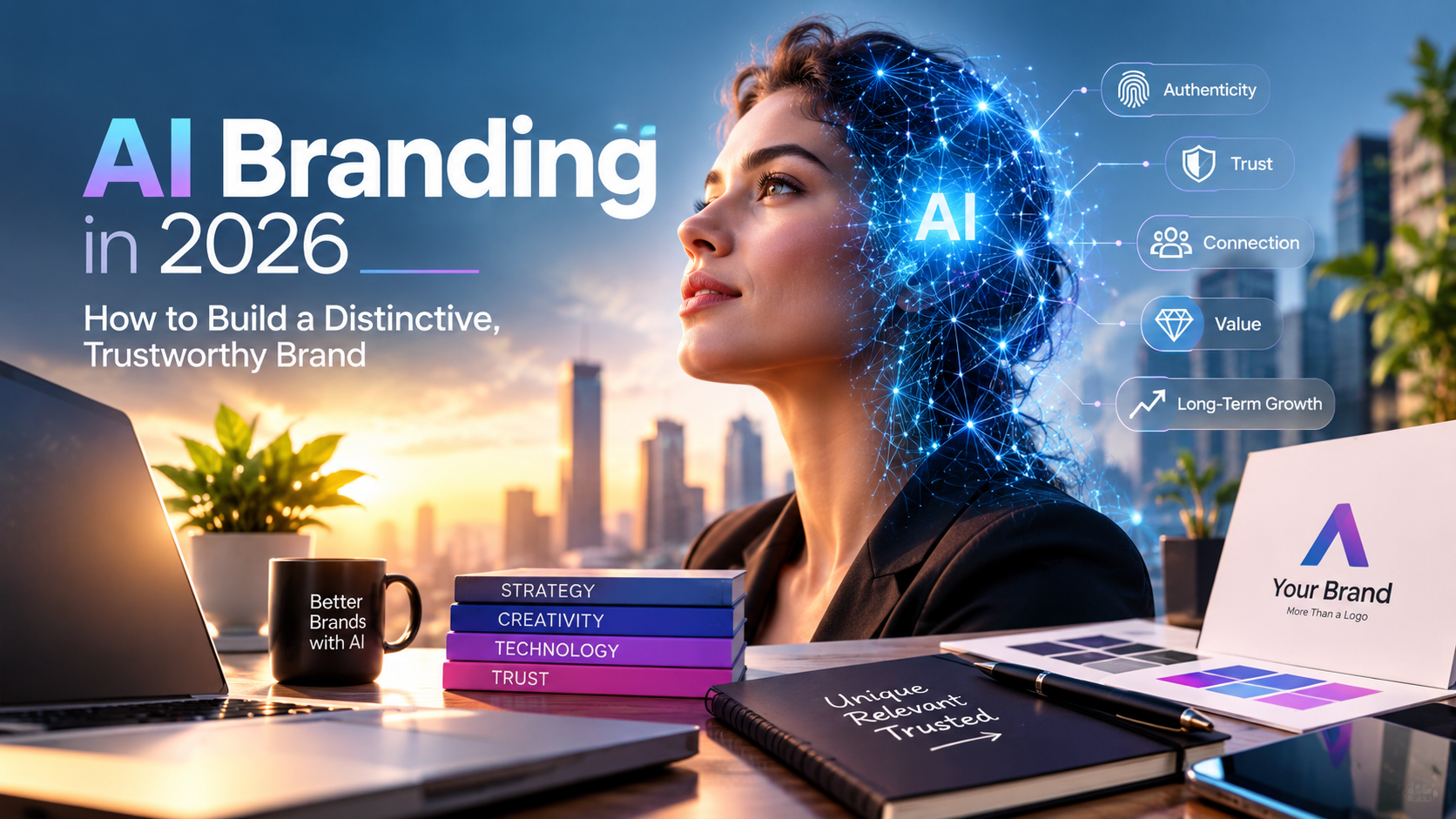
Introduction: Branding Has Entered a New Era
AI branding is becoming one of the most important developments in modern brand strategy. For decades, branding was largely about controlling how a company presented itself. A company could develop a logo, select its colors and typography, write a brand story, create advertising campaigns and publish a set of brand guidelines. The basic objective was relatively straightforward:
Make the brand recognizable and consistent.
That objective still matters. But the environment in which brands operate has changed dramatically. Generative artificial intelligence can now produce images, text, video, presentations, advertising concepts and other creative assets at a speed that would have been impossible only a few years ago.
At the same time, consumers are increasingly discovering companies through AI-powered interfaces, recommendation systems and conversational search. This creates a new branding challenge. A company no longer controls every description of its brand.
An AI system may summarize what customers, websites, reviews, publications and other sources say about a company and then generate an answer for a potential customer.
WARC’s 2026 research describes this as a fundamental change in brand building: marketers increasingly need to understand both their brands and the AI systems through which consumers discover information. This means branding is moving beyond visual identity. The future of branding is increasingly about building a brand that is:
- Distinctive
- Coherent
- Trustworthy
- Human
- Recognizable
- Consistent across channels
- Understandable to both people and machines
The important question is no longer simply:
“How should our brand look?”
It is:
“What should our brand consistently mean wherever people encounter it?”
What Is AI Branding?
AI branding refers to the use of artificial intelligence in brand strategy, identity development, content production, customer experience and brand management. However, AI branding should not be confused with simply using AI to generate a logo.
A company can create thousands of AI-generated images and still have a weak brand. The technology is not the brand. AI is a tool that can help a company develop, express and manage its brand. A strong AI branding system can involve:
- Brand strategy
- Audience research
- Naming
- Positioning
- Visual identity
- Logo development
- Brand voice
- Content creation
- Image generation
- Video production
- Campaign development
- Localization
- Customer experience
- Brand monitoring
- Search visibility
- AI-assisted analysis
The strategic challenge is maintaining a recognizable identity while producing more content across more channels. That is why AI makes branding more important rather than less important. When content becomes cheap and abundant, distinctiveness becomes more valuable.
Why AI Is Changing Brand Building
Generative AI dramatically reduces the cost and time required to produce creative material. A marketing team can now create dozens of concepts in a fraction of the time traditionally required. A designer can explore more visual directions. A content team can produce more variations. A company can localize campaigns faster. A small business can produce professional-looking marketing material without maintaining a large creative department.
This is an enormous opportunity. But it creates an equally important problem. If everyone can produce attractive images, polished videos and professionally written copy, then these elements become less effective as differentiators. Imagine that 1,000 competing brands use similar AI tools. They may produce:
- Similar photographs
- Similar gradients
- Similar typography
- Similar slogans
- Similar advertising language
- Similar social media posts
The output may look professional. But it may also become interchangeable. This is one reason the strategic value of a strong brand identity is increasing. WARC’s 2026 guidance emphasizes that AI can accelerate creative production, but human guidance remains essential. The winning strategy is therefore not:
AI instead of branding.
It is:
Better branding + intelligent use of AI.
From Brand Consistency to Brand Coherence
One of the most important ideas emerging in contemporary branding is the distinction between consistency and coherence. Traditional brand guidelines often focused heavily on consistency. For example:
- Always use this logo.
- Use these colors.
- Use this font.
- Use this spacing.
- Use this photography style.
These rules remain useful. But modern brands operate across a much larger number of touchpoints. A brand may appear on:
- A website
- YouTube
- Packaging
- Product labels
- Advertising
- AI-generated content
- Customer service
- Retail environments
- Mobile applications
- Search engines
- AI assistants
It is unrealistic to expect every touchpoint to look identical. Instead, the brand needs to remain coherent. Coherence means that different expressions of the brand still feel like they belong to the same organization.
- The visual design can change.
- The format can change.
- The message can change.
- The platform can change.
But the underlying identity remains recognizable.
WARC’s 2026 research explicitly identifies coherence as a strategic response to fragmentation, arguing that brands need their communications and experiences to add up to a recognizable identity. This is particularly important in the age of AI. AI can generate thousands of variations. A strong brand system determines which variations still belong to the brand.
Trust Is Becoming a Competitive Brand Advantage
As AI-generated content becomes more common, trust becomes increasingly valuable. Consumers can encounter highly polished content without knowing:
- Who created it?
- Whether the claim is accurate.
- Whether the image is real.
- Whether the testimonial is authentic.
- Whether the company actually behaves as it claims.
This creates what Gartner describes as a new scarcity: not simply attention, but trust. The company argues that trusted human perspectives, expert proof and community advocacy are becoming important differentiators in an environment where content can be produced cheaply and abundantly.
Brand trust therefore cannot be created by visual design alone. A company must demonstrate that its behavior supports its promises. For example, a brand that claims:
“We care about quality.”
needs evidence. That evidence could include:
- Product quality
- Transparent processes
- Customer reviews
- Expert knowledge
- Certifications
- Case studies
- Reliable customer service
- Consistent product experience
This is especially important because AI systems can aggregate information from multiple sources. WARC argues that generative AI changes branding partly because AI systems can summarize the accumulated signals surrounding a brand rather than simply repeating the company’s own narrative. In other words:
Your brand is increasingly what the evidence says it is.
Distinctive Brand Assets Matter More Than Ever
A distinctive brand asset is an element that helps consumers recognize a brand. Examples include:
- Logos
- Colors
- Shapes
- Characters
- Typography
- Taglines
- Sounds
- Packaging elements
- Visual devices

A brand’s assets
The important concept is distinctiveness. A brand asset should not merely look attractive. It should help consumers identify the brand quickly.
Research discussed by WARC in 2026 emphasizes the advertising value of distinctive brand assets such as logos, jingles and mascots. These assets can help consumers attribute advertising to the correct brand and connect campaigns over time.
This has a major implication for AI branding. If AI allows brands to generate unlimited creative variations, companies need stable elements that anchor those variations. For example, a company could produce 100 AI-generated campaign images.
- The photography might change.
- The environment might change.
- The people might change.
But the brand could consistently retain:
- A distinctive color system
- A recognizable typography system
- A specific graphic shape
- A consistent tone
- A recognizable logo treatment
The result is creative flexibility without losing recognition.
The Human Advantage in AI Branding
One of the strongest branding trends emerging around AI is the renewed importance of human creativity. As synthetic content becomes easier to produce, genuinely human signals can become more valuable. This can include:
- Handcrafted details
- Real photography
- Real people
- Founder stories
- Behind-the-scenes content
- Expert opinions
- Original illustrations
- Physical materials
- Human imperfections
- Real customer experiences
Recent consumer research has also highlighted authenticity as a major factor in brand perception. A 2025 Clutch survey reported that 97% of respondents said authenticity influences their decisions. The precise percentage should not be generalized to every market, but the direction is strategically important.
Consumers may increasingly ask:
“Is there a real person behind this?”
This does not mean brands should reject AI. Instead, brands should use AI to amplify human creativity rather than erase it.
How Generative AI Can Strengthen a Brand
AI can provide enormous value when it operates inside a clearly defined brand system.
1. Faster creative exploration
A creative team can generate many initial directions quickly. Instead of spending hours producing ten rough concepts, the team can explore dozens and select the strongest ideas for human refinement.
2. Localization
A global brand can adapt messaging for different languages and markets. However, localization should not mean literal translation. Cultural context still requires human judgment.
3. Content production
AI can help create:
- Social media concepts
- Blog drafts
- Campaign variations
- Product descriptions
- Advertising concepts
- Video scripts
4. Customer research
AI can analyze large amounts of qualitative feedback and identify recurring themes.
5. Brand monitoring
Companies can use AI-assisted systems to identify how customers describe the brand across different sources.
6. Personalization
Brands can create variations of messages for different audiences while maintaining core brand principles. The key principle is:
AI should increase the range of brand expression without destroying brand recognition.
Where AI Can Damage a Brand
The same technology that creates opportunities can also create serious branding problems.
Generic visual identity
If a brand relies entirely on generic AI imagery, its communications can become visually interchangeable.
Inconsistent messaging
AI-generated content can use different tones and vocabulary from one campaign to another.
Hallucinated claims
AI systems can produce inaccurate information. A false product claim can damage trust.
Fake authenticity
Trying to make AI-generated content appear genuinely human can create a backlash if audiences discover the deception.
Brand dilution
If every employee uses AI independently, a company may produce hundreds of inconsistent brand expressions.
Overproduction
More content does not automatically mean better branding. A company can publish ten times more content while becoming less memorable. The solution is not necessarily less AI. The solution is better governance.
Building a Strong Brand Identity in 2026
A modern brand identity should begin with strategy. Before selecting colors or designing a logo, define:
Brand Purpose
Why does the company exist?
Target Audience
Who is the brand designed to serve?
Positioning
Why should customers choose this brand instead of alternatives?
Value Proposition
What meaningful benefit does the company provide?
Personality
If the brand were a person, how would it behave and communicate?
Brand Promise
What can customers reliably expect?
Differentiation
What makes the company meaningfully different? Only after these questions are answered should visual identity development begin.
Visual Identity in the Age of AI
Visual identity remains one of the most important components of branding. But modern visual identity systems need to be more flexible. A strong system should define:
- Logo
- Logo variations
- Color palette
- Typography
- Iconography
- Photography
- Illustration
- Graphic elements
- Layout principles
- Motion principles
- Packaging applications
- Digital applications
For a company involved in printing and packaging, this becomes particularly important. A visual identity must work not only on a website but also on:
- Labels
- Boxes
- Flexible packaging
- Business cards
- Signage
- Promotional materials
- Social media
- Digital advertising
A good brand identity should survive changes in medium. A logo that looks excellent on a website but fails on a small product label is not a complete identity system.
Brand Voice and Verbal Identity
Branding is not only visual. A company also needs a recognizable verbal identity. For example, two companies can sell similar products while sounding completely different. One might be:
- Technical
- Precise
- Professional
Another might be:
- Friendly
- Playful
- Conversational
The important thing is intentionality. Brand voice guidelines should define:
- Vocabulary
- Sentence structure
- Tone
- Formality
- Humor
- Technical language
- Words to use
- Words to avoid
This becomes even more important when AI is used to produce content. Without a defined voice, AI-generated content can quickly become inconsistent.
Designing Brand Guidelines for an AI-Driven World
Traditional brand guidelines often explain how humans should use brand assets. Modern guidelines also need to explain how AI systems should use them. For example, an organization could establish:
Visual rules
Which colors are mandatory? Which compositions are preferred? Which visual styles are prohibited?
Writing rules
What tone should AI-generated copy use? What terminology should be avoided?
Image-generation rules
What types of imagery represent the brand? What should never be generated?
Review rules
Which AI-generated materials require human approval?
Accuracy rules
Which claims must be verified before publication?
Legal rules
Which assets can and cannot be used? This turns a static brand book into a brand operating system.
AI, Search and Brand Discovery
Another major shift in branding is how people discover information. Traditional search often required users to type keywords and browse multiple pages. AI-powered search and conversational interfaces can provide synthesized answers. This changes the role of brand information.
A company should make sure its digital presence clearly communicates:
- Who the company is
- What it does
- Who it serves
- Where it operates
- What makes it different
- What products or services it provides
- What evidence supports its claims
WARC notes that consumer queries made through LLMs can reveal Category Entry Points—situations and needs that trigger consumer interest in a category or brand.
This means brand strategy and search strategy are increasingly connected. A brand should not only ask:
“What keywords should we rank for?”
It should also ask:
“What questions should people associate our brand with?”
Building Brands for Humans and AI
The modern brand has two audiences. The first is obvious:
Humans.
The second is increasingly important:
Machines.
AI systems interpret information about companies.
- They summarize websites.
- They compare products.
- They answer questions.
- They recommend solutions.
Therefore, brands need to be understandable to machines without becoming robotic to humans. This requires:
- Clear information architecture
- Consistent company descriptions
- Accurate product information
- Strong authoritative pages
- Consistent naming
- Structured data where appropriate
- Reliable external references
- Consistent brand terminology
But technical optimization alone is insufficient. The underlying brand must actually be coherent.
If a company claims to be a premium manufacturer on its website but has inconsistent information, poor reviews and contradictory descriptions elsewhere, AI systems may reflect that inconsistency.
That is why WARC’s 2026 research argues that brands increasingly need organizational coherence, not simply better storytelling.
How Small Businesses Can Use AI Branding
AI branding is not limited to global corporations. Small businesses may benefit even more because AI can reduce the cost of creative production. A small company can use AI to support:
- Brand research
- Competitor analysis
- Naming exploration
- Content creation
- Image concepts
- Video concepts
- Social media
- Website copy
- Presentation design
- Localization
But there should still be a human strategic layer. A small business should first create a simple brand foundation. For example:
Brand positioning
Premium label and packaging solutions for pharmaceutical and supplement companies.
Brand personality
Precise, professional, innovative and trustworthy.
Visual identity
Clean typography, controlled color palette and technically sophisticated layouts.
Once those decisions exist, AI can help produce hundreds of assets without reinventing the brand every time.
A Practical AI Branding Framework
A practical AI branding process can be divided into eight steps.
Step 1: Define the brand
Establish:
- Mission
- Audience
- Positioning
- Promise
- Personality
Step 2: Identify differentiation
Ask:
Why should customers remember this company?
Step 3: Build distinctive assets
Develop:
- Logo
- Colors
- Typography
- Shapes
- Visual devices
- Verbal assets
Step 4: Build the brand system
Create rules for how these assets work together.
Step 5: Define AI usage
Determine where AI can generate content and where humans must approve it.
Step 6: Create content
Use AI to scale production while maintaining the brand system.
Step 7: Monitor perception
Analyze customer feedback, reviews, search results and public discussions.
Step 8: Improve continuously
Branding should evolve without losing its core identity. This framework creates an important balance:
Consistency where recognition matters. Flexibility where creativity matters.
Common AI Branding Mistakes
Mistake 1: Thinking AI-generated content is a brand strategy
AI can produce content. It cannot automatically determine what your brand should mean.
Mistake 2: Copying competitors
AI makes it extremely easy to reproduce familiar visual patterns. But similarity reduces differentiation.
Mistake 3: Producing too much content
More posts do not automatically create more brand equity. A smaller number of memorable, distinctive assets may be more valuable.
Mistake 4: Removing humans from the process
Human judgment remains important for:
- Strategy
- Taste
- Culture
- Context
- Ethics
- Storytelling
Mistake 5: Changing the identity constantly
A brand should evolve. But constant reinvention can destroy recognition.
Mistake 6: Ignoring physical branding
For packaging and printing companies, this is especially important. A digital identity must also work in the physical world. The brand needs to survive:
screen → label → packaging → retail → customer experience
The Future of Branding
The future of branding will not be defined by AI alone. Instead, AI will become part of a larger brand ecosystem. The strongest companies will combine:
Strategy + Creativity + Technology + Human Judgment + Evidence
AI will make creative production faster. But faster production does not necessarily create stronger brands. The brands that win will be those that use technology while protecting what technology cannot easily manufacture:
- Meaning
- Trust
- Distinctiveness
- Reputation
- Human connection
- Cultural relevance
WARC’s 2026 research similarly argues that strong brands become increasingly important in an AI-mediated world because they provide a stable, recognizable signal amid information abundance.
Distinctive brand assets will remain important. Brand identity will remain important. Brand strategy will remain important. But the operating model will change. Brand teams will increasingly need to manage not just campaigns, but systems.
Conclusion: The Best AI Branding Is Still Human
The rise of generative AI does not make branding obsolete. It makes strong branding more valuable. When anyone can generate an attractive image, the image itself becomes less distinctive. When anyone can create a polished advertisement, the advertisement alone becomes less differentiating. When anyone can generate thousands of words, content volume becomes less meaningful. What remains difficult to copy is a coherent brand built over time.
A strong brand has:
- A clear position
- Distinctive assets
- Consistent meaning
- Credible evidence
- Human character
- Memorable experiences
The opportunity in AI branding is therefore not to replace human creativity. It is to amplify it.
The best brands in 2026 will use AI to move faster without becoming generic, to create more without losing coherence, and to personalize experiences without sacrificing recognition.
The central question for every brand should therefore be:
If AI makes everyone faster, what will make our brand recognizable?
The answer is not more content.
It is a stronger identity, clearer strategy, distinctive assets and a brand experience that consistently proves what the company stands for. That is the real opportunity of branding in the age of AI.
Sources & Further Reading
- WARC — The WARC Guide to brand building in the age of gen AI
- WARC — Branding in the age of Generative AI
- WARC — Why brand is critical in the age of gen AI
- WARC — Distinctive brand assets increase advertising impact
- Gartner — In the AI Era, Trust Scarcity Is Rewriting the Rules of Brand Growth
- Clutch — Brand Authenticity Survey
To build a strong internal linking structure around this article, connect it to relevant pages on the website:
- About Amin Lesani — link to the personal profile page
- Brand Identity & Packaging Services — link to the relevant services page
- Label & Packaging Portfolio — link to the main portfolio archive
- Brand Stories — link to the Brand Stories category
- Design & Printing Articles — link to the relevant blog category
Thank you very much for choosing us.