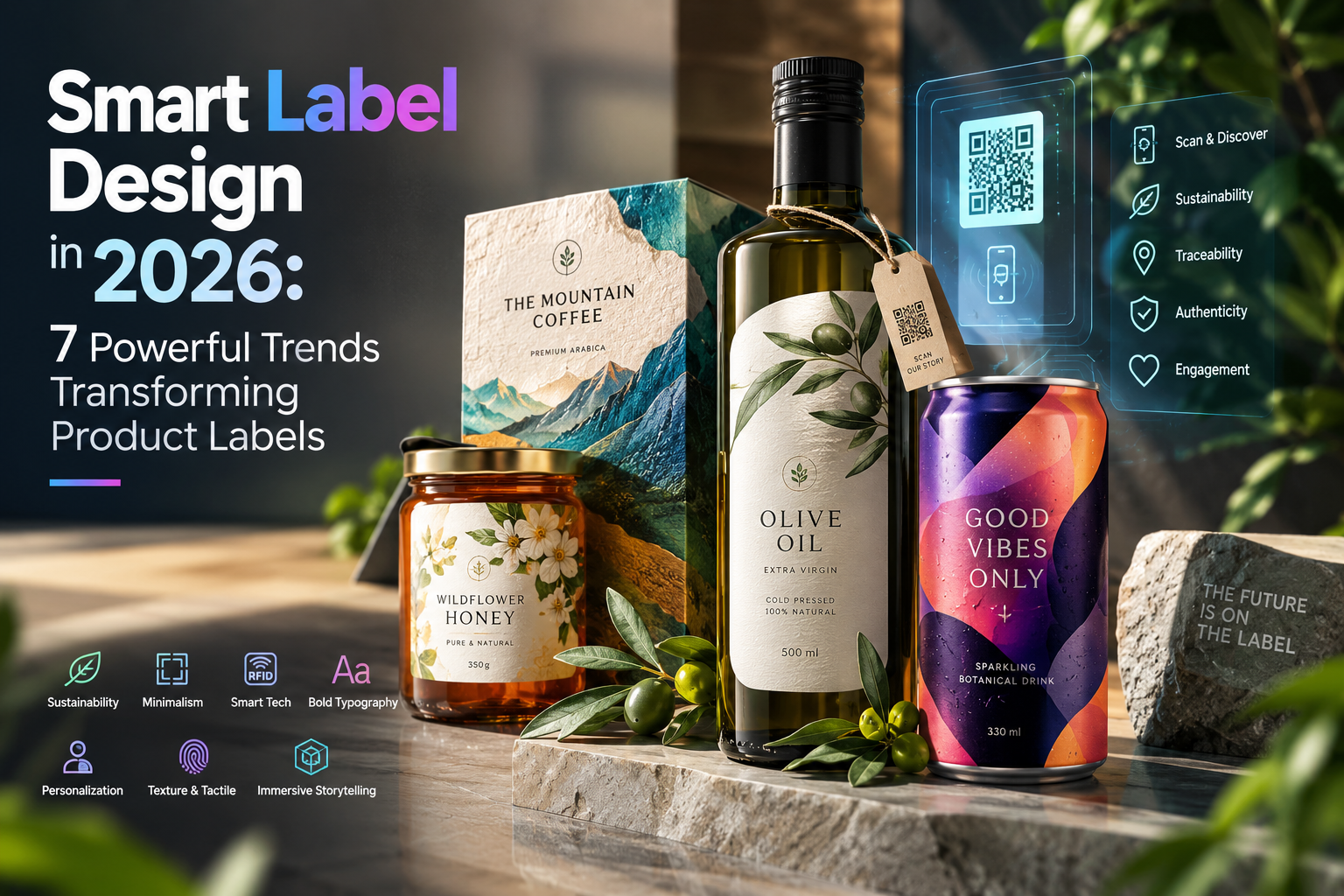
The Era of the Smart Label
Smart label design is becoming one of the most important developments in packaging and label printing in 2026.
For decades, a product label had a relatively straightforward job. It identified the product, displayed the brand, communicated essential information, and helped the product stand out on a shelf.
That role has not disappeared. But the label is becoming much more than a printed surface.
Today’s label can connect a physical product to a digital experience, provide product information, support traceability, enable authentication, communicate sustainability information, personalize an individual product, and create a more memorable physical experience through tactile and decorative printing techniques.
This transformation is being driven by several technologies and market forces at the same time. QR codes and 2D barcodes are becoming increasingly important. GS1’s Sunrise 2027 initiative is accelerating the industry’s transition toward 2D barcodes capable of carrying more information than traditional 1D barcodes.
At the same time, label manufacturers and packaging brands are investing in tactile finishes, variable data, digital printing, personalization, and more sophisticated embellishment. Industry coverage in 2026 points to tactile effects, expressive typography, variable-data production, and digital printing as important developments in label design.
The result is a new generation of labels that combine visual design, physical interaction, printing technology, and digital identity.
This article explores seven of the most important label design trends in 2026 and explains how brands can use them to create more distinctive, functional, and future-ready product labels.
What Is Smart Label Design?
Smart label design is the process of designing a product label that combines traditional visual communication with additional digital, functional, or interactive capabilities.
A conventional label might contain:
- Brand name
- Product name
- Logo
- Ingredients
- Instructions
- Barcode
- Regulatory information
A smart label can contain all of these elements while also creating a connection to digital information. For example, a customer might scan a QR code on a product and access:
- Product specifications
- Authentication
- Manufacturing information
- Instructions
- Videos
- Product registration
- Loyalty programs
- Sustainability information
- Product origin
- Promotions
- Reordering
- Customer support
This means the label becomes a gateway between the physical product and digital ecosystem.
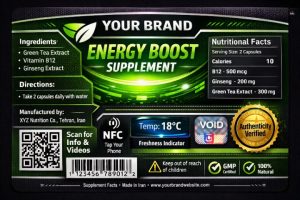
Details of a smart label
Avery Dennison described this transformation in 2026 by noting that QR codes, RFID and other digital triggers are turning smart labels into consumer engagement channels rather than passive packaging elements.
The important point is that smart label design should not mean simply adding a QR code to an existing design. The digital component should be considered as part of the label architecture from the beginning.
Why Label Design Is Changing in 2026
There are several reasons why label design is evolving rapidly. First, consumers have access to more products than ever before. A brand therefore has only a short amount of time to attract attention. Second, consumers increasingly expect product information to be accessible.
They may want to know where a product was manufactured, what ingredients it contains, how it should be used, whether it is authentic, and whether the company makes sustainability claims that can be verified. Third, retailers and supply chains need better identification and traceability. Finally, printing technology has become more flexible.
Digital printing makes it easier to produce short runs, variable information, seasonal designs, personalized labels, and multiple versions without the same production constraints associated with traditional long-run workflows.
Industry observations from 2026 indicate that variable-data production and shorter, more flexible label runs are becoming increasingly relevant to packaging brands. Together, these developments are changing what brands expect from a label. The label is no longer simply a decoration applied to a package. It is increasingly becoming an information interface.
Trend #1: Smart Labels and Digital Product Identity
The first major trend is the emergence of digital product identity. Traditionally, a barcode primarily helped identify a product for retail and inventory systems. Modern 2D technologies can support much richer data and digital experiences.
This makes it possible for a product to have a persistent digital identity that can connect the physical item to online information. For example, a product label could identify:
- The product
- Product variant
- Batch
- Lot
- Expiration information
- Manufacturing information
- Digital product page
The exact data structure depends on the technology and implementation. GS1 explains that 2D barcodes can support additional information for areas such as inventory management, traceability, product authentication, recalls, and consumer engagement.
This creates an important opportunity for label designers. The designer is no longer working only with typography, color, and imagery. The designer must also consider:
- Where does the digital identity belong?
- How large should the code be?
- How much visual attention should it receive?
- How can it be integrated without damaging the hierarchy of the label?
This is where smart label design becomes different from simply adding technology to packaging.
Sunrise 2027 and the Rise of 2D Barcode Labels
One of the most important developments affecting label design is GS1’s Sunrise 2027 initiative. The initiative aims to enable retail point-of-sale systems to read 2D barcodes, such as QR Codes and GS1 DataMatrix, alongside traditional 1D barcodes by the end of 2027.
This does not mean that traditional EAN or UPC barcodes suddenly become useless. During the transition, brands may need to support both systems depending on their markets, retailers, and implementation requirements. GS1 US explicitly describes a transition period in which 1D and 2D codes can coexist.
For label designers, this creates a new design challenge. A label may need to accommodate:
Brand identity + product information + 1D barcode + 2D barcode + regulatory information + digital interaction.
Space is limited. Therefore, the layout must become more intelligent. Instead of treating the barcode as an afterthought, designers should reserve space for it during the initial layout process. This is particularly important for small labels.
QR Codes Are Becoming Part of Label Design
QR codes have existed for years, but their role in packaging is changing. Previously, many brands used QR codes as optional promotional elements. Today, they can become part of the product’s digital identity and information architecture. A QR code could lead to:
- Product information
- Authentication
- Usage instructions
- Product videos
- Recipes
- Technical documentation
- Customer support
- Loyalty programs
- Sustainability information
GS1 US notes that 2D barcodes can provide additional product information and consumer engagement opportunities while also supporting supply-chain functions. But there is a major design principle:
A QR code should not dominate the label unless the brand strategy requires it.
It should have sufficient contrast, adequate quiet space, and enough physical size to scan reliably. The final printed code should also be tested.
A QR code that works perfectly on a designer’s monitor can fail after printing because of:
- Insufficient contrast
- Substrate characteristics
- Ink spread
- Lamination
- Varnish
- Distortion
- Poor resolution
- Incorrect sizing
Therefore, QR code integration is both a design problem and a production problem.
GS1 Digital Link and Connected Labels
One particularly interesting development is GS1 Digital Link. Instead of thinking of a barcode simply as a number, Digital Link enables a product identifier to connect to web-based information.
GS1 explains that Digital Link can connect a product’s unique identity to online sources of information. This opens the possibility of creating a label that can act as a permanent digital gateway. For example:
Physical label → QR code → Product identity → Digital experience
The destination could potentially change over time without requiring the physical label to be redesigned for every new digital campaign, depending on the implementation.
This creates a major strategic advantage. The physical label can remain relatively stable while the digital experience evolves. For brands, that means the label becomes more durable as a communication asset.
Trend #2: Tactile Label Design
While digital technology is becoming more important, one of the most interesting reactions to a digital world is the increased value of physical experience. This is why tactile label design is gaining attention. A label can communicate quality through touch. Techniques include:
- Embossing
- Debossing
- Raised UV
- Tactile varnish
- Soft-touch finishes
- Textured substrates
- Metallic effects
- Foil stamping
- Micro-patterns
Industry reporting in 2026 highlights tactile finishes and texture as important directions in label design. The reason is straightforward. A digital image can communicate what a label looks like.
It cannot fully communicate how it feels. When a consumer physically picks up a product, tactile elements can create another layer of brand communication. For premium products, cosmetics, beverages, specialty foods, and luxury packaging, this can be particularly powerful.
Trend #3: Premium Label Embellishment
Label embellishment is also becoming more sophisticated. Modern printing workflows allow brands to combine multiple effects:
- Metallic foil
- Cold foil
- Hot foil
- Spot UV
- Raised varnish
- Embossing
- Soft-touch
- Matte and gloss combinations
- Textured materials
The goal is not simply to make a label look expensive. The best embellishment supports the brand’s personality. For example, a pharmaceutical brand may require precision and clarity. A luxury cosmetic brand may benefit from metallic details and tactile typography. A premium beverage may use textured paper and subtle embossing. A children’s product may use brighter colors and playful tactile effects.
The important principle is:
Embellishment should reinforce brand meaning rather than become decoration without purpose.
Industry coverage in September 2026 describes embellishment as increasingly integrated with repeatable production processes and hybrid printing technologies.
Trend #4: Variable Data and Personalized Labels
Personalization is another major direction in modern label printing. Instead of printing thousands of identical labels, digital printing allows brands to introduce controlled variations. For example:
- Different names
- Different illustrations
- Different messages
- Different product versions
- Different regional information
- Unique serial numbers
- Promotional codes
- Individual authentication codes
This creates opportunities for campaigns that would have been difficult or expensive with traditional workflows. A beverage company might produce a limited campaign with hundreds of different designs. A cosmetics company could produce seasonal editions. A pharmaceutical product might include variable information for identification and traceability. A premium brand could produce numbered editions. The label therefore becomes a variable communication platform.
Trend #5: Sustainable Label Design
Sustainability is no longer only a question of the package itself. The label can influence the recyclability, material efficiency, and overall sustainability profile of packaging.
Avery Dennison has highlighted increasing attention to sustainable labels and packaging, including the relationship between materials, product communication, and environmental expectations. Designers therefore need to think beyond appearance. Questions include:
- Is the label material appropriate for the package?
- Is the adhesive compatible with the recycling process?
- Can unnecessary material be eliminated?
- Can ink and finishing choices be optimized?
- Is the sustainability claim verifiable?
- Can the label communicate disposal or recycling information clearly?
Sustainable label design should not simply use a green color and a leaf icon. It should be supported by real material and production decisions. This is increasingly important because consumers and regulators are paying more attention to environmental claims.
Trend #6: Digital Printing and Short-Run Labels
Digital printing is changing the economics and flexibility of label production. Traditional printing remains extremely important for many high-volume applications. However, digital printing offers advantages when brands need:
- Short runs
- Multiple SKUs
- Personalization
- Variable data
- Seasonal designs
- Fast turnaround
- Prototyping
- Market testing
A brand can test several label designs without committing to extremely large quantities. This creates an important change in the relationship between design and production.
Previously, designers might create one final design that would remain unchanged for a long production cycle. Today, brands can potentially experiment more frequently. A label can become an iterative marketing asset.
Design → Print → Test → Learn → Improve → Reprint.
This is especially useful for emerging brands and products entering competitive categories.
Trend #7: Labels Designed for Authentication and Traceability
Counterfeiting and supply-chain visibility are major concerns for many industries. This is particularly important in:
- Pharmaceuticals
- Supplements
- Cosmetics
- Alcoholic beverages
- Luxury goods
- Electronics
- High-value products
Modern labels can incorporate technologies such as:
- QR codes
- Serialized identifiers
- RFID
- NFC
- Tamper-evident features
- Variable data
- Security printing
Smart labels can therefore play a role in verifying products and tracking their movement. Avery Dennison has highlighted how item-level digital identities can support supply-chain visibility, waste reduction, tracking, and data collection. For pharmaceutical and supplement packaging in particular, this creates an opportunity to combine visual branding with functional security.
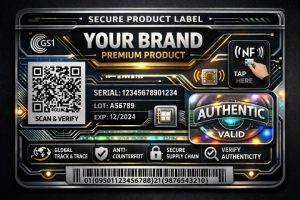
Anti-counterfeiting label
How Smart Labels Combine Physical and Digital Experiences
The most effective smart label design does not treat physical and digital experiences as separate. Instead, they should work together. Imagine a supplement bottle. The physical label communicates:
Brand → Product → Benefit → Trust → Usage
The QR code adds:
Authentication → Detailed information → Instructions → Support
The tactile finish adds:
Premium perception → Physical differentiation
The serialized identifier adds:
Traceability → Security
The result is a multilayered product experience. This is much more powerful than simply putting a QR code beside a logo.
Designing a Smart Label Without Destroying Its Visual Identity
Technology can easily make a label visually complicated. The designer must therefore maintain hierarchy.
A useful hierarchy is:
Level 1 — Brand
What company or product is this?
Level 2 — Product
What is the product?
Level 3 — Key benefit
Why should the consumer care?
Level 4 — Supporting information
What else does the consumer need to know?
Level 5 — Digital and regulatory elements
How can the user scan, verify, trace, or understand the product? The mistake is allowing every element to compete for attention. Smart label design should make the label smarter, not busier.
The Role of Typography in Modern Label Design
Typography is one of the most powerful elements of label design. In 2026, expressive typography is becoming more visible alongside tactile and maximalist approaches. Industry trend coverage points toward larger type, distinctive lettering, and more expressive combinations as brands seek stronger shelf presence.
However, expressive typography must not compromise readability. A label must often communicate information at a very small physical scale. Designers therefore need to balance:
Personality + readability + hierarchy.
For pharmaceutical and supplement products, readability may take priority. For premium cosmetics, typography may become a major part of the visual identity. For food products, typography can create appetite, personality, and category recognition.
Color Strategy for Smart Product Labels
Color remains one of the fastest ways for consumers to recognize a product. However, modern label systems should consider color as a scalable architecture. A brand may need:
- Primary brand color
- Secondary colors
- Product-category colors
- SKU colors
- Seasonal colors
- Promotional colors
The system should allow variation without destroying brand recognition. For example, a supplement company could use one consistent brand architecture while assigning different accent colors to:
- Vitamins
- Minerals
- Sports supplements
- Herbal products
- Children’s products
This allows the product range to remain coherent while making individual products distinguishable.
Designing QR Codes Without Making Labels Look Generic
One of the biggest challenges in smart label design is integrating the QR code. A poorly integrated QR code can make a premium product look technical and generic. Instead, designers should consider:
- Position
- Scale
- Contrast
- Quiet zone
- Surrounding typography
- Supporting call-to-action
- Relationship to the brand
- Printing process
The QR code should have enough visual separation to scan reliably. At the same time, it should feel like part of the label rather than an element that was added five minutes before production.
For GS1 implementations, the exact technical requirements should always be checked against the applicable GS1 specifications and the intended use case before artwork goes to press. GS1 provides implementation guidance and testing resources for 2D barcodes.
Smart Labels for Pharmaceutical and Supplement Products
Pharmaceutical and supplement labels are particularly suitable for smart label technologies. These products often require extensive information. A physical label has limited space. A connected digital experience can provide additional information without putting every detail onto the physical surface. For example:
Physical label
- Product name
- Dosage
- Key ingredients
- Manufacturer
- Regulatory information
- Barcode
Digital experience
- Detailed instructions
- Product documentation
- Authentication
- FAQs
- Videos
- Batch information
- Customer support
This approach can make the physical label cleaner while providing deeper information digitally. For regulated products, however, digital information should supplement—not improperly replace—mandatory physical labeling requirements.
Smart Labels for Food and Beverage Products
Food and beverage brands can use smart label design for:
- Recipes
- Origin stories
- Farm information
- Product information
- Promotions
- Loyalty
- Authentication
- Sustainability information
Imagine buying a specialty coffee package and scanning its label. Instead of simply seeing a generic homepage, the customer could see:
Origin → Farm → Region → Processing method → Roasting profile → Brewing guide
The label becomes the entrance to the product story. This is a powerful example of how physical packaging can become an interactive brand experience.
Premium cosmetics are another category where smart label design can be especially effective. The physical label can focus on:
- Luxury
- Typography
- Texture
- Color
- Material
- Embellishment
while the digital layer can provide:
- Product tutorials
- Ingredient information
- Authenticity
- Usage instructions
- Brand storytelling
This allows the brand to preserve a sophisticated physical appearance without sacrificing information.
How Printing Technology Is Changing Label Design
Designers increasingly need to understand printing technology. A design is not finished when it looks good on a monitor. It is finished when it works in production.
Important considerations include:
Substrate
Paper, film, transparent materials, metallic substrates, and specialty stocks behave differently.
Ink
Ink characteristics affect color, contrast, durability, and barcode readability.
Finishing
Lamination, varnish, foil and embossing can change the physical and visual result.
Printing process
Flexographic, digital, offset and hybrid workflows offer different capabilities.
Variable data
Serialized information and personalization require appropriate production workflows.
Barcode testing
Digital files must not simply be assumed to work after printing. The printed result should be verified. This is why a strong label design process involves designers, prepress specialists, printers, and brand teams.
Common Smart Label Design Mistakes
Mistake 1: Adding technology at the end
A QR code should not be an afterthought. Plan it during layout development.
Mistake 2: Making the QR code too small
A code that cannot reliably scan creates a poor user experience.
Mistake 3: Using too many visual effects
Embossing, foil, metallic colors, gradients, patterns and QR codes can quickly create visual noise.
Mistake 4: Ignoring production
What looks perfect digitally may not reproduce correctly in print.
Mistake 5: Using sustainability claims without evidence
Green visual language is not proof of sustainability.
Mistake 6: Treating every product as identical
Different categories have different information and regulatory requirements.
Mistake 7: Forgetting the digital destination
A QR code is only valuable if the destination provides a useful experience.
A Practical Workflow for Designing Smart Labels
A professional workflow can follow these steps.
Step 1 — Understand the product
Identify:
- Category
- Target customer
- Market
- Product positioning
- Regulatory requirements
Step 2 — Define the brand hierarchy
Determine:
- Logo
- Product name
- Key message
- Supporting information
Step 3 — Identify digital requirements
Determine whether the label needs:
- QR
- GS1 Digital Link
- NFC
- RFID
- Authentication
- Serialization
Step 4 — Choose materials
Select the appropriate substrate and adhesive system.
Step 5 — Develop the visual system
Define:
- Typography
- Color
- Imagery
- Icons
- Patterns
Step 6 — Add tactile and finishing elements
Determine whether:
- Embossing
- Foil
- Spot UV
- Raised varnish
- Soft-touch
adds meaningful value.
Step 7 — Prepare production artwork
Consider:
- Bleed
- Die line
- Barcode
- Color separation
- Variable data
- Finishing layers
Step 8 — Produce a proof
Do not rely exclusively on a screen preview.
Step 9 — Test the final printed label
Check:
- Readability
- Color
- Barcode scanning
- QR scanning
- Finishing
- Adhesion
- Physical appearance
Step 10 — Approve mass production
Only after the physical and digital elements work together should the design move to full production.
The Future of Label Design
The future of label design will not be purely digital. It will be physical + digital. The physical label will continue to perform critical functions:
- Recognition
- Shelf impact
- Information
- Brand expression
- Tactile experience
The digital layer will add:
- Data
- Authentication
- Traceability
- Personalization
- Interaction
- Dynamic information
This combination is likely to make labels increasingly valuable as brand assets. The label could become a persistent identity layer connecting the product, consumer, retailer, manufacturer, and digital ecosystem.
GS1’s move toward 2D barcodes is one of the clearest examples of this transition. The organization’s goal is to enable 2D barcode use at retail POS globally by the end of 2027, while 1D barcodes can continue to coexist during the transition.
At the same time, tactile printing and embellishment demonstrate that physical interaction is not becoming irrelevant. In fact, as more communication moves into digital environments, the physical experience of a well-designed label may become even more valuable.
Conclusion
Smart label design is no longer simply about making a product look attractive. The modern label is becoming a combination of:
Brand Identity + Information + Printing Technology + Digital Identity + Physical Experience.
The most important trends shaping label design in 2026 include:
- Smart labels
- 2D barcodes
- QR-based digital experiences
- GS1 Digital Link
- Tactile finishes
- Premium embellishment
- Variable data
- Personalization
- Sustainable materials
- Digital printing
- Authentication
- Traceability
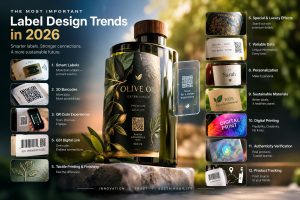
The most important trends shaping label design in 2026
The biggest opportunity is not to use every technology available. It is to choose the technologies that genuinely improve the product experience. A premium cosmetic product may benefit from tactile finishes and digital storytelling. A pharmaceutical product may benefit more from traceability and authentication. A food product may benefit from QR-based recipes and origin information. A supplement may combine authentication, product information, and serialized identification.
The best label is therefore not necessarily the most technologically advanced label. It is the label in which design, printing, technology and brand strategy work together. As the industry moves toward the 2027 2D barcode transition, brands that begin planning their label systems now can design packaging that is not only visually distinctive, but also more connected, traceable, interactive and future-ready.
The label of the future is not just something consumers look at.
It is something they can interact with.
References
- GS1 US — What Is GS1 Sunrise 2027?
- GS1 — QR Codes with GS1 Standards
- GS1 Switzerland — 2D Codes
- GS1 US — GS1 Digital Link for Retailers
- Avery Dennison — Smart Labels Becoming Media Channels
- Avery Dennison — Rethinking Packaging: How Sustainable Labels Are Reshaping the Future
- StickerGiant — 2026 Label Design Trends
- LabelSwift — 2026 Label Design Trends
- PrintLovers — Mainstream Embellishment: The New Language of Labels
To build a strong internal linking structure around this article, connect it to relevant pages on the website:
- About Amin Lesani — link to the personal profile page
- Brand Identity & Packaging Services — link to the relevant services page
- Label & Packaging Portfolio — link to the main portfolio archive
- Brand Stories — link to the Brand Stories category
- Design & Printing Articles — link to the relevant blog category
Thank you very much for choosing us.