


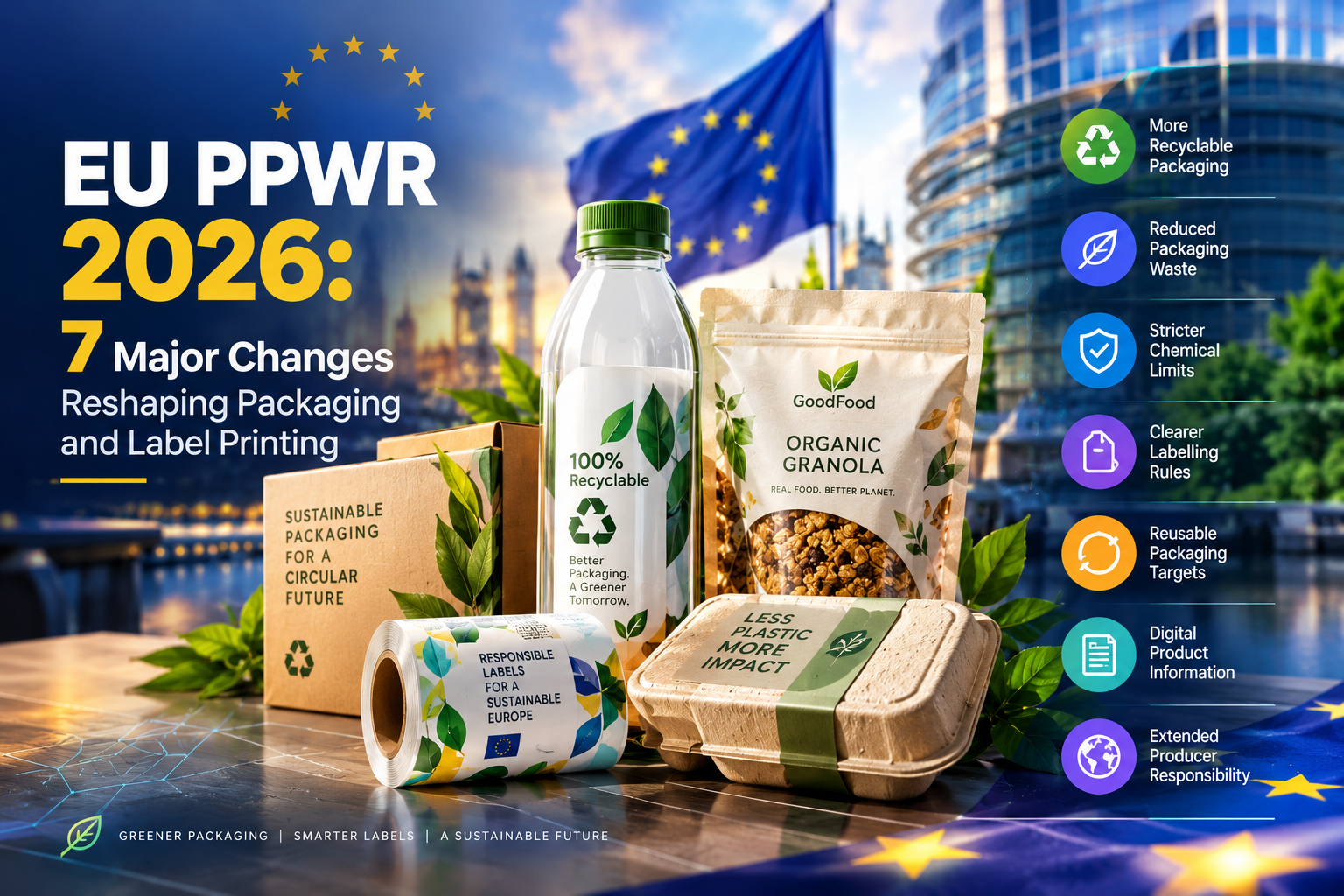
What is the new European law?
The packaging industry has entered a new regulatory era. On 12 August 2026, the European Union’s Packaging and Packaging Waste Regulation (PPWR) began to apply across the EU, introducing a harmonized framework covering packaging sustainability, labeling, waste prevention, reuse, recycling and other parts of the packaging life cycle.
For consumers, the change may initially seem relatively simple. For packaging manufacturers, brands, designers and printers, however, the implications are much broader. Packaging is no longer being evaluated only by how attractive it looks on a retail shelf.
Companies increasingly have to consider:
- What material is being used?
- Can the packaging be recycled?
- How much packaging is necessary?
- What information must appear on the packaging?
- How should consumers identify the material?
- Can digital information replace or complement physical markings?
- Are environmental claims accurate?
- Does the packaging contain substances of concern?
- Can the packaging fit into future circular economy systems?
This makes EU PPWR 2026 highly relevant to the printing and labeling industry. The European Commission describes the regulation as a harmonized framework intended to reduce packaging waste, improve recycling and strengthen the circular economy, while replacing fragmented national requirements with common EU rules.
For printers and label manufacturers, the important point is that packaging compliance increasingly starts before the printing press.
It starts during packaging design. A label that looks beautiful but creates problems for recycling, material identification, digital information or regulatory compliance may no longer be sufficient.
The result is a major shift:
Packaging design is becoming a combination of branding, engineering, sustainability, information management and compliance.
This article explains seven major changes brought into focus by EU PPWR 2026 and examines what they mean for packaging designers, label printers and brands.
What Is the EU PPWR?
The Packaging and Packaging Waste Regulation, commonly known as PPWR, is EU Regulation 2025/40.
It establishes requirements covering the environmental sustainability and labeling of packaging and addresses areas including packaging waste prevention, reuse, recycling and extended producer responsibility. Unlike a narrow rule focused only on recycling, the PPWR takes a much broader life-cycle approach.
The regulation applies to packaging regardless of the material used and covers packaging and packaging waste associated with industry, manufacturing, retail, distribution, offices, services and households. This is important because packaging is not just a consumer-facing object.
It is part of a much larger system:
Raw materials → packaging design → manufacturing → printing → filling → distribution → retail → consumer use → collection → sorting → recycling or disposal
The PPWR attempts to address this wider system. That means packaging companies increasingly need to think beyond the production stage.
When Did the EU PPWR Become Applicable?
The PPWR entered into force in February 2025, but its requirements are being introduced progressively. A major milestone arrived on 12 August 2026, when the regulation began applying across the European Union. The European Commission published an official announcement on 11 August 2026 confirming that the new packaging rules would apply from the following day.
This distinction is important. The PPWR is not a single deadline after which every packaging requirement suddenly changes overnight. Instead, different requirements have different implementation dates. Some requirements are already relevant.
Other important measures will take effect later. For example, the European Commission states that a harmonized packaging labeling system will apply from 2028, while additional measures concerning packaging waste prevention, certain single-use plastic packaging, reuse and other circular economy requirements are scheduled for later stages, including 2030.
Therefore, companies should not interpret 12 August 2026 as:
“Everything must already be redesigned.”
It is better understood as:
The transition has entered its regulatory application phase, and companies need to prepare their packaging systems for the requirements that follow.
For the printing industry, that preparation is especially important because packaging artwork, printing specifications and production tooling can have long development cycles.
Why the New Regulation Matters to the Printing Industry
At first glance, PPWR may appear to be an environmental regulation. But printing is directly connected to packaging.
A printed label can contain:
- Material information
- Recycling information
- Product information
- Regulatory information
- Barcodes
- QR codes
- Brand identity
- Environmental claims
- Instructions
- Digital access points
Therefore, changing packaging requirements can directly affect artwork and printing workflows. Intergraf, the European federation representing the graphic industry, specifically notes that PPWR affects European printers in two ways. First, printers may have obligations when supplying printed packaging to customers. Second, printers themselves use packaging in their own operations and can therefore also fall under relevant PPWR requirements. Intergraf also points out that non-EU printers can be affected when supplying packaging to EU customers or placing packaged printed products on the EU market.
This is particularly relevant for international suppliers. A printing company does not necessarily need to be located inside the EU to encounter PPWR-related requirements. If its products enter the EU market, the regulation may become relevant to the supply chain.

Change #1: Packaging Is Now Regulated Across Its Entire Life Cycle
One of the most important changes is the broader life-cycle approach. The PPWR establishes requirements covering the life cycle of packaging, including environmental sustainability and labeling, while also addressing waste prevention, reuse, collection and recycling.
This changes how designers and manufacturers should think about packaging. In the past, a packaging project could be approached primarily as:
Brand strategy → visual design → artwork → printing → production
Increasingly, the process needs to look more like:
Brand strategy → product requirements → material selection → recyclability → regulatory requirements → labeling → artwork → prepress → printing → finishing → supply chain
This is a significant change. The designer is no longer operating independently from the material engineer or printer. The printer is no longer simply receiving a finished artwork file. And the brand cannot always decide on packaging aesthetics first and compliance later. Instead, packaging becomes a multidisciplinary project.
Change #2: Packaging Labeling Is Moving Toward Harmonized Rules
Labeling is one of the areas where the PPWR has direct consequences for printed packaging. The regulation establishes requirements for harmonized packaging labels intended to help consumers understand packaging material composition and improve waste sorting.
The regulation provides that, from 12 August 2028, or another later date depending on the relevant implementing acts, packaging placed on the market will need a harmonized label containing information on material composition to facilitate consumer sorting.
This has major implications for packaging design. Imagine a designer working on a bottle label today. The artwork may already contain:
- Logo
- Product name
- Product description
- Claims
- Ingredients
- Barcode
- QR code
- Legal information
- Manufacturer details
- Recycling information
Now another harmonized labeling requirement may need to be incorporated. That means the designer must manage limited physical space much more carefully. This is particularly important for small labels. A large shipping carton has plenty of space. A small pharmaceutical, cosmetic or supplement label may not. Therefore, the future of packaging design will require better information hierarchy.
The question is no longer simply:
“Where can we put this information?”
It becomes:
“What information must be physical, what can be digital, what has to be prominent, and how can all of it coexist without destroying the visual identity?”
Change #3: Digital Information and QR Codes Become More Important
One of the most interesting aspects of the PPWR is its recognition of digital information. The regulation provides for the use of QR codes and other standardized, open digital data carriers in certain packaging contexts. For reusable packaging, for example, a QR code or other standardized digital data carrier can provide information about reusability, reuse systems, collection locations and tracking-related information.
This represents an important direction for packaging. The physical label has limited space. Digital systems do not have the same physical limitations. Instead of printing every possible piece of information on a label, certain information can be connected to a digital layer.
The concept can be represented as:
Physical package → QR Code → Digital information → Extended product experience
This creates new opportunities for packaging designers. A QR code can potentially connect the customer to:
- Product information
- Recycling instructions
- Reuse information
- Authentication
- Supply chain information
- Product documentation
- Brand storytelling
- Customer support
But there is an important design principle here.
Digital packaging should complement physical packaging, not simply add more clutter.
A QR code placed randomly in the corner of a premium label is not necessarily good packaging design. The code should be integrated into the information hierarchy.
Change #4: PFAS Restrictions Affect Food-Contact Packaging
Another major development entering application with the PPWR concerns PFAS, or per- and polyfluoroalkyl substances. The European Commission announced that from 12 August 2026, food-contact packaging containing PFAS above the specified limits can no longer be placed on the EU market.
PFAS have been used in some food packaging applications because of properties such as water and grease resistance. Examples mentioned by the European Commission include:
- Takeaway containers
- Fast-food wrappers
- Microwave popcorn bags
- Bakery paper
- Pizza boxes
The new restriction is therefore particularly relevant to food packaging. Although PFAS is not simply a “printing ink issue,” it demonstrates something important for packaging manufacturers:
Material selection and packaging compliance are increasingly connected.
A designer may select a particular substrate or finish for visual or functional reasons. But the packaging supplier must also consider whether the complete packaging construction satisfies the relevant requirements. This means packaging projects may require closer coordination between:
Designer + material supplier + converter + printer + brand owner
Change #5: Recyclability Becomes a Design and Production Issue
Recyclability is becoming increasingly important in packaging design. The PPWR establishes a broader framework intended to improve packaging sustainability and recycling and includes requirements that will progressively affect packaging placed on the EU market.
The European Commission states that requirements intended to ensure that all packaging is recyclable are among the measures that apply from 2030. This means packaging designers should start thinking about recyclability before a design is finalized. For example:
- Is the label compatible with the intended packaging material?
- Does the adhesive create difficulties for recycling?
- Does a decorative layer complicate sorting or recycling?
- Is the combination of materials unnecessarily complex?
- Can the packaging be separated into appropriate material streams?
These questions may become more important during the design brief. This is particularly relevant for labels. A visually impressive label can contain several components:
- Face stock
- Adhesive
- Ink
- Varnish
- Lamination
- Foil
- Embossing
- Specialty coatings
Every additional component can affect production and potentially end-of-life considerations. That does not mean decorative labels will disappear. It means designers and printers need to understand the consequences of material and finishing choices.
Change #6: Recycled Content and Material Selection Become More Important
Another major part of the PPWR concerns recycled content, particularly in plastic packaging. The regulation establishes recycled-content requirements for plastic packaging, with implementation occurring over time. The European Commission identifies mandatory use of recycled plastic waste in new plastic packaging among measures applying from 2030.
This creates another connection between packaging design and material sourcing. A designer might specify:
“Use this particular plastic.”
But in a future-oriented packaging workflow, the conversation may need to become:
“What material is being used, what recycled content is required, what certification or documentation is available, and how does the material behave during printing and conversion?”
For packaging printers, this can affect:
- Substrate sourcing
- Color reproduction
- Ink behavior
- Surface treatment
- Adhesion
- Finishing
- Quality control
Different substrates can behave differently on press. Therefore, sustainability requirements can eventually become production requirements.
Change #7: Packaging Claims Face Greater Scrutiny
One of the most important consequences for brand designers is the increasing importance of environmental claims. Terms such as:
- Eco-friendly
- Green
- Sustainable
- Recyclable
- Compostable
- Environmentally friendly
- Plastic-free
can have significant marketing value. But environmental claims can also create confusion if they are vague or unsupported.
Article 14 of the PPWR addresses environmental claims related to packaging properties regulated by the regulation. Such claims must meet specified requirements and relate to properties exceeding applicable minimum requirements, with the relevant information supported by technical documentation.
This means packaging design cannot treat environmental messaging as purely decorative copy. A statement such as:
“100% recyclable packaging“
should not be used simply because the marketing department likes it. The actual packaging construction and applicable requirements need to support the claim. This will likely increase the importance of collaboration between:
Marketing + Legal + Packaging Engineering + Design + Printing
What Does EU PPWR 2026 Mean for Label Design?
For label designers, the most obvious impact is space. Labels already have limited physical area. A modern label might need to contain:
- Brand identity
- Product information
- Legal information
- Barcode
- Digital identifier
- Recycling information
- Environmental information
- Mandatory symbols
This creates a hierarchy problem. The solution is not to make everything smaller. Making every text element smaller eventually damages usability. Instead, designers need to develop stronger information architecture. For example:
Primary information
- Brand
- Product name
- Main product benefit
Secondary information
- Variant
- Flavor
- Size
- Key features
Regulatory information
- Ingredients
- Warnings
- Required information
Machine-readable information
- Barcode
- QR code
- Digital identifier
Sustainability information
- Material
- Recycling
- Relevant environmental information
This approach allows the designer to protect the brand’s visual identity while still accommodating compliance requirements.
What Does EU PPWR 2026 Mean for Label Printing?
The printing industry will increasingly need to treat compliance as part of production planning. A printer may receive a final artwork file and assume that the responsibility is entirely on the customer. That approach can become risky. Printers should understand:
- What material is being printed?
- Where will the packaging be sold?
- Which regulations apply?
- What information is mandatory?
- Are variable data involved?
- Does the barcode need verification?
- Is there a digital component?
- Is the substrate appropriate?
- Does finishing affect functionality?
- Are environmental claims supported?
Intergraf specifically highlights that PPWR can impose different obligations depending on the role a printer plays in the packaging supply chain. This suggests an important evolution in the printing business.
The printer of the future may increasingly become a technical packaging partner, rather than simply a production vendor.
What Does EU PPWR 2026 Mean for Packaging Designers?
Packaging designers will probably feel the impact earlier than many people expect. A designer needs to know not only how to create a visually compelling package, but also how the design interacts with:
- Materials
- Recycling
- Printing
- Digital identification
- Compliance
- Manufacturing
- Consumer behavior
This does not mean every graphic designer must become a packaging engineer. It means the design process needs to involve the right specialists earlier. For example, before finalizing a label design, a professional team may need to ask:
- What substrate are we using?
- How will it be printed?
- Is it compatible with the packaging?
- Does the finishing process affect recyclability?
- What mandatory information is expected?
- Will there be a QR code?
- How large does it need to be?
- What happens if the product is sold in several EU markets?
The earlier these questions are answered, the less expensive redesign becomes.
What Does EU PPWR 2026 Mean for International Printers?
This is particularly relevant for companies outside Europe. A non-EU printer may think:
“We are not in Europe, so European packaging regulations do not concern us.”
That assumption can be incorrect. Intergraf explicitly notes that non-EU printers can be affected when supplying packaging to EU customers or when placing packaged printed products on the EU market. For international printing companies, this creates a competitive opportunity. A printer that understands EU packaging requirements can become more valuable to European customers. Instead of selling:
Printing
the company can sell:
Packaging design + prepress + compliant material selection + printing + finishing + quality control
That is a much stronger value proposition.
How PPWR Could Change Packaging Workflows
Traditional workflow:
Customer → Designer → Artwork → Printer → Production
Future-oriented workflow:
- Brand strategy
- Packaging engineering
- Material selection
- Regulatory review
- Label and packaging design
- Digital information planning
- Prepress
- Printing
- Finishing
- Quality control
- Compliance documentation
This is a more complex workflow, but it can also create better products. The key change is that compliance moves upstream. Instead of discovering a problem after the artwork has been approved, companies can identify the problem during the design stage. This reduces:
- Redesign
- Waste
- Production delays
- Material waste
- Incorrect printing
- Regulatory risk
The Importance of Digital Packaging Information

One of the most interesting long-term consequences of PPWR is the increasing role of digital information.
The regulation explicitly provides for digital data carriers in several contexts and also seeks to avoid unnecessary multiplication of labels by allowing relevant information to be accessible through the same digital data carrier where applicable. This is important. Instead of putting five different QR codes on a package, the future may favor a more structured digital information architecture.
One digital gateway could potentially provide access to different information layers. For example:
- QR Code
- Product information
- Recycling information
- Authentication
- Reuse information
- Brand content
- Customer service
The physical package remains important. But it becomes the entry point to a larger digital ecosystem.
What Brands Should Do Now
Brands should not wait until every future PPWR deadline arrives. A better strategy is to begin a packaging audit.
Step 1: Create a packaging inventory
List:
- Products
- SKUs such as Unique labels that have QR codes
- Packaging formats
- Materials
- Labels
- Markets
Step 2: Identify EU products
Determine which products are:
- Sold in the EU
- Exported to EU customers
- Manufactured for EU markets
Step 3: Review materials
Document:
- Substrate
- Adhesive
- Ink
- Coating
- Lamination
- Finishing
Step 4: Review labeling
Check:
- Existing symbols
- Recycling information
- Barcodes
- QR codes
- Environmental claims
Step 5: Review digital opportunities
Determine whether QR codes or other digital data carriers could simplify information management.
Step 6: Review artwork systems
If a company has hundreds of SKUs, create a scalable packaging design system rather than manually redesigning every product.
Step 7: Coordinate with suppliers
Talk to:
- Printers
- Label manufacturers
- Packaging converters
- Material suppliers
- Compliance specialists
The goal is not simply to react to regulation. The goal is to build a packaging system capable of adapting to future requirements.
A Practical EU PPWR 2026 Readiness Checklist
A company preparing packaging for the European market can use this basic checklist.
Packaging
- Packaging materials identified
- Packaging components documented
- Recyclability reviewed
- Unnecessary packaging reviewed
- Material combinations reviewed
Labels
- Label material documented
- Adhesive documented
- Printing process documented
- Finishing documented
- Recycling considerations reviewed
Design
- Mandatory information identified
- Information hierarchy established
- Space reserved for required markings
- Barcode checked
- QR code checked if applicable
Digital
- Digital information architecture defined
- QR code destination controlled
- Product data maintained
- Digital information updated when required
Marketing
- Environmental claims reviewed
- Sustainability claims supported
- Claims are not misleading
- Technical documentation available
Production
- Printer understands the packaging specification
- Material supplier documented
- Proofing completed
- Barcode verification completed
- Final artwork approved
This checklist is not a substitute for legal advice or a formal compliance assessment, but it illustrates how packaging teams can organize their workflow.
The Bigger Trend: Packaging Is Becoming More Data-Driven
The PPWR should not be viewed only as a sustainability regulation. It is also part of a larger transformation in packaging. Packaging is becoming:
Physical + Digital + Traceable + Data-driven
Consider the evolution.
Traditional packaging
Logo + Product + Information
Modern packaging
Logo + Product + Information + QR Code
Emerging packaging
Physical packaging + Digital identity + Traceability + Sustainability data + Consumer interaction
This transformation creates new opportunities for label printers. A company that can only print a label competes primarily on:
- Price
- Quality
- Delivery
A company that can provide:
- Label design
- Packaging design
- Variable data
- Digital identifiers
- Security features
- Finishing
- Technical prepress
- Compliance-oriented production
can compete on much greater value.
Why This Matters for Pharmaceutical and Supplement Packaging
The impact is particularly interesting for pharmaceutical and supplement companies. These products often require a large amount of information on relatively small packaging. They may also need:
- Batch numbers
- Expiration dates
- Barcodes
- Regulatory information
- Safety information
- Authentication
- Traceability
This makes them excellent candidates for a combination of physical and digital information. However, the PPWR itself does contain specific exceptions and qualifications for certain medicinal and veterinary packaging where other EU legislation already governs labeling and where space or safe use considerations apply.
Therefore, companies in regulated sectors should not assume that a general packaging rule applies identically to every product. This is another reason why packaging projects should be reviewed on a product-by-product basis.
What Happens Next?
The most important point is that 12 August 2026 is not the end of the PPWR story. It is the beginning of a multi-year implementation process. The European Commission states that harmonized packaging labeling is expected from 2028, while additional measures concerning waste prevention, reuse, recyclability and recycled content will be introduced over subsequent years.
The Commission is also continuing work on secondary legislation and implementation measures. This means packaging companies should monitor the regulation rather than treating it as a one-time compliance project. A company that redesigns packaging once and never revisits it may quickly become outdated. A better approach is to build an adaptable packaging system.
Conclusion
EU PPWR 2026 is one of the most important regulatory developments affecting packaging in Europe in recent years.
Its significance extends far beyond recycling. The regulation touches packaging design, materials, labeling, waste prevention, reuse, digital information, environmental claims and the wider packaging life cycle.
For the printing and label industry, the implications are particularly important. The printer is increasingly becoming part of the packaging value chain rather than simply the final production step. The designer must consider compliance and material choices earlier.
The brand must think about packaging claims more carefully. The packaging manufacturer must understand how materials behave throughout their life cycle. And digital technologies such as QR codes and standardized data carriers are becoming increasingly relevant to the future of packaging information.
The biggest opportunity may therefore not be simply to comply with the PPWR. It is to use the transformation to build better packaging systems. The winning packaging companies of the next decade are likely to be those that combine:
Design + Printing + Materials + Sustainability + Data + Technology.
For brands selling into Europe, the message is straightforward:
Do not wait for the next deadline to rethink your packaging.
Start with your materials. Review your labels. Audit your artwork. Check your environmental claims. Plan your digital information. Talk to your printer. And build a packaging system that can evolve as the PPWR continues to take effect.
The future of packaging will not be defined by one technology or one material. It will be defined by how effectively design, printing, regulation, sustainability and digital information work together.
Sources & Further Reading
- European Commission — New EU rules on packaging enter into application
- EUR-Lex — Regulation (EU) 2025/40
- European Commission — Packaging Waste
- Intergraf — PPWR
- EUR-Lex — Article 12 / Labelling of Packagin
To build a strong internal linking structure around this article, connect it to relevant pages on the website:
- About Amin Lesani — link to the personal profile page
- Brand Identity & Packaging Services — link to the relevant services page
- Label & Packaging Portfolio — link to the main portfolio archive
- Brand Stories — link to the Brand Stories category
- Design & Printing Articles — link to the relevant blog category
Thank you very much for choosing us.